Ed Bartlett expects a lot of his customer base, he asks would-be buyers to buy his bib shorts before he makes them, then wait around eight weeks after orders close for them to ship.
Kostüme can afford it, Bartlett argues, because it does not make kit it has not already sold. The Bristol-based brand runs entirely on pre-order batches. Bartlett says this removes the speculative stock and discounting built into apparel, and frees up money for construction. Most of the industry's sustainability effort goes into fabric. Bartlett's case is that the bigger problem comes earlier, at the point where a brand decides how much to make.
 Photo: FERGUS COYLE PHOTO
"The current sustainability efforts are all just downstream, sticking plasters," he said. "All of the talk is about recycled fabrics and it's all still terrible and it's all still downstream from the overproduction issue. If you don't fix the overproduction issue, then all the rest of the stuff, it's not irrelevant, but it's a lot less relevant."
On October 20, Label Collective co-founder Julian Roberts announced that the brand would move to pre-order from spring/summer 2027, and named Bartlett as the reason. "Every season our industry makes clothing on a guess. Make plenty, hope it sells, mark down the rest," Roberts wrote. "Ed Bartlett at KOSTÜME has been doing it for years and proving it works."
How a batch works
Kostüme began as a lockdown project and made its first commercial sale in 2022. It arrived at what Bartlett calls "a terrible moment for the industry". Brands had overproduced after the pandemic boom, "so everything was just on sale all the time". Kostüme sells only at full price.
Sell first, make second
One pair of bib shorts, two routes from idea to rider
Same shorts, opposite order. One route makes the run on a forecast, before anyone buys. The other takes payment first, while a short window is open, and makes nothing yet.
Made on a guess, the run has to find buyers: some at full price, some marked down, some never. Kostüme shuts the window, then makes what was paid for, plus spares.
Not quite stockless. Spares cover size swaps. Returned and leftover pieces go to a waitlist, and whatever is still left is sold ready to ship.
The trade is time. Far less is made on a guess, but the rider pays up front and waits, and the making clock only starts when the window shuts.
The model came from outside cycling. Bartlett has worn Gustin, an American menswear label, for years. Gustin buys limited runs of fabric and puts a garment into production only once customers have funded it. Bartlett said that, as far as he was aware, it was the first pre-order apparel brand.
Kostüme's version runs on a monthly cycle, which the brand moved to this year. Each new design launches at midday on the last Friday of the month and stays on sale for just over two weeks, covering two weekends, before closing at midnight on a Sunday. Kostüme takes payment when the order is placed. Each product is typically limited to 350 pieces. The autumn/winter collection, Edit012, closed on October 11, with fulfilment advertised from December 1.
"Once that batch is closed, that's it. We never reproduce that particular design or anything," Bartlett said. "We don't produce excess that we then discount."
 Photo: FERGUS COYLE PHOTO
He rejects the idea that the limited runs are a sales tactic. "You also get that kind of inbuilt uniqueness to it without it being marketing-driven scarcity. But we're not doing this for marketing purposes. We're doing it because it's our business model."
Production takes about six weeks for most products and eight for the bib shorts. Kostüme counts that period from the close of the batch, not from the day a customer pays.
 Photo: FERGUS COYLE PHOTO
The system is not entirely stockless. Kostüme orders roughly 20% more than it has sold, so new customers whose kit does not fit can exchange it. After the batch closes, a waitlist collects people who missed it. Once size exchanges are done, leftover and returned pieces go to that list. Whatever remains goes into a small Ready to Ship range for customers who will not wait.
Bartlett said returns run at about 3%. About 2% goes straight to the waitlist and roughly 1% is left over. "Most brands get 40% returns," he said.
Bartlett's central point is that traditional brands overproduce on purpose, because their numbers reward it.
"In general, a brand will sell 30% at full price, 30% at a discount, and 40% will go completely unsold," he said. Factories give better prices for bigger runs. Brands then build their customer acquisition, marketing and distribution costs into a model that already assumes those proportions.
Within that model, he said, "it's actually more expensive for a brand, a traditional brand, to miss out on a sale that they could have made because it's not in stock than it is to have excess products they never sell and get destroyed".
People outside cycling make a similar case. Francois Souchet, a circular-economy strategist, told the Guardian that "brands are afraid of missing out on a sale, so they always order too much, rather than not enough". The same reporting identifies minimum order quantities and setup costs as reasons production runs grow longer.
Making textiles accounts for around 80% of their total climate impact, the European Environment Agency estimates. That means most of the climate impact has already occurred before anyone wears the clothing. Producing kit that never sells therefore creates emissions without providing any use. Even using recycled or lower-impact fabrics does not eliminate that waste if the finished garment is never worn.
Kostüme turns that saved waste into specification. Bartlett said the brand spends double to triple what other brands spend on product. Not all of the difference reaches the garment, because small runs lose the volume discounts that big brands get. Almost all of the supply chain is in Italy, and Bartlett said prices sit slightly below the market leaders. "We're actually undercutting them, that shows you how much waste there must be in the system, right?"
The brand's 2022 launch statement described how the original range was planned to use as little material as possible. Five fabrics served a range of seven products with different technical designs. Materials were shared across products: bib-short fabric was used for arm and knee warmers, the cap and neck warmer made use of jersey offcuts, while cap fabric was used to make the jersey pockets. The silicone gripper was printed onto the bib fabric after cutting rather than bought pre-printed on a roll, which Kostüme said reduced fabric wastage.
"We have almost no product failures. We have almost no returns, almost no repairs," Bartlett said.
 Photo: James Busby
The cost falls on the customer, who has to wait. "We're definitely losing some people at the early stage of the funnel for that, but the advantage of our model is that we're not driven by scale, right?" Bartlett said.
He said customers tend to describe the delay positively. Kit ordered at the end of one month usually arrives in the third week of the next, when pay day can feel a long way off. "It's almost like a gift from the past," he said. "You haven't paid for it because past you last month paid for it already."
Bartlett puts Kostüme's returning-customer rate at 56% and its average email open rate at about 70%. He attributes the second figure to not filling inboxes with promotions.
Could the big brands follow?
Asked whether a brand such as Rapha or Le Col could adopt the model, Bartlett was sceptical, because the change would impact every part of the business, and disruption is never easy for a business battling shrinking revenues.
"I think it would be very hard for them to pivot because it's how it impacts every part of the business, right?" he said. "There's the fact that a lot of people that buy those brands are already hooked on the discounting drug."
The product would also have to change. "The reason people wait for our products isn't because they're limited edition," he said. In his account, customers wait because the kit is good, and it is good because the model funds roughly three times the spend. An established brand would probably have to run pre-order alongside its existing business and move across gradually. With product development taking around two years, he believes that would be slow.
Textile Exchange makes a similar point about the wider industry. Its Reimagining Growth analysis lists growth expectations built into financial structures and business norms as an obstacle, and says pressure for short-term returns often outweighs sustainability goals. Bartlett's version is that "people are unable to forecast negative growth, right? Degrowth is just not acceptable."
Rapha's 2026 Impact Report, covering 2025, shows how volume affects a large brand's footprint. Rapha cut its Scope 3 emissions from 11,035 to 8,988 tonnes of CO2e. The report attributes that partly to refining its range, which lowered overall product volumes, and to buying less fabric. Excess fabric stood at 1.47% of material volume, and Rapha aims to reach 0.5% by 2030, partly by ordering only what it needs. That figure measures leftover fabric rather than unsold finished garments.
Rapha's material targets have moved more slowly. Only 52% of its range met its preferred-materials criteria in 2025, against a 90% goal set in 2021. Measured by fabric volume the figure was 66%. Bartlett is dismissive of repair schemes in general: "The reason the repair scheme exists is because the products aren't very good anymore and they're falling to bits." Rapha's own scheme repairs crash damage free of charge and fixed 3,778 products last year.
Smaller brands face fewer obstacles. Iris Slappendel's IRIS already works with low minimum order quantities and small runs. Label Collective plans pre-order windows in January and February, with "a little kept back for anyone who misses the window".
Shops are another obstacle, because they usually order stock in advance. In September, Kostüme opened its first Partner Studio at Port Velo Cycle Works near Bristol. Customers there try kit on and order through a Kostüme-run microsite, while the shop gets regional exclusivity and an allocation from production runs. "We never planned to offer apparel, because the existing model doesn't really make much sense," Port Velo co-founder Simon Andrews said in the company's announcement. "The stock commitment – and the over-reliance on heavy discounting to shift seasonal stock – simply wasn't attractive to us."
There is a limit to what pre-order solves. Making only what sells removes unsold stock, but it does not mean people buy less. The EEA's summary pairs longer use, reuse and recycling with "reductions in overall consumption". Bartlett places the responsibility on brands. "It's our job to educate consumers better, to make the products better, to make our products have less impact," he said. "People aren't going to suddenly start living in caves."
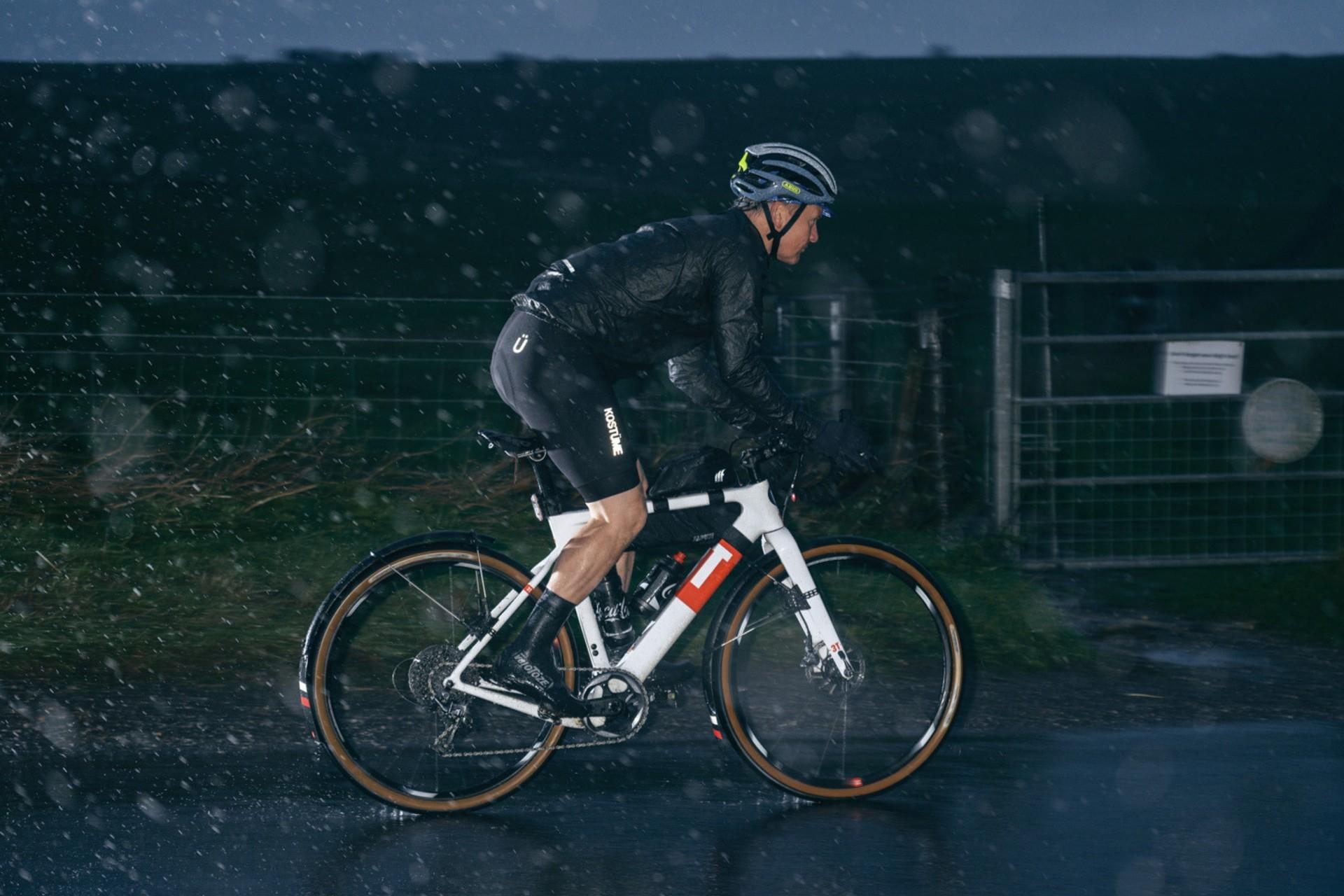
Bartlett says he avoids using the word sustainability in Kostüme's marketing because greenwashing has undermined customers' trust. "It's almost like a swear word," he said. His argument is that brands should explain how they reduce their impact rather than claim to be sustainable, a description he rejects for his own business too. "No brand is sustainable, including us," he said. Bartlett was speaking in the extremes, as his model clearly favours sustainability, but he’s correct that all production, and consumption, has an impact that can’t be ignored.
He hopes others will copy the model rather than treat it as Kostüme's advantage. "My goal is that people copy what we're doing. I'm not doing this to be a competitive differentiator. The brand and the products are the differentiator," he said.
"The hope is that future founders will look at this and say, well, that's obviously a better way of doing it."