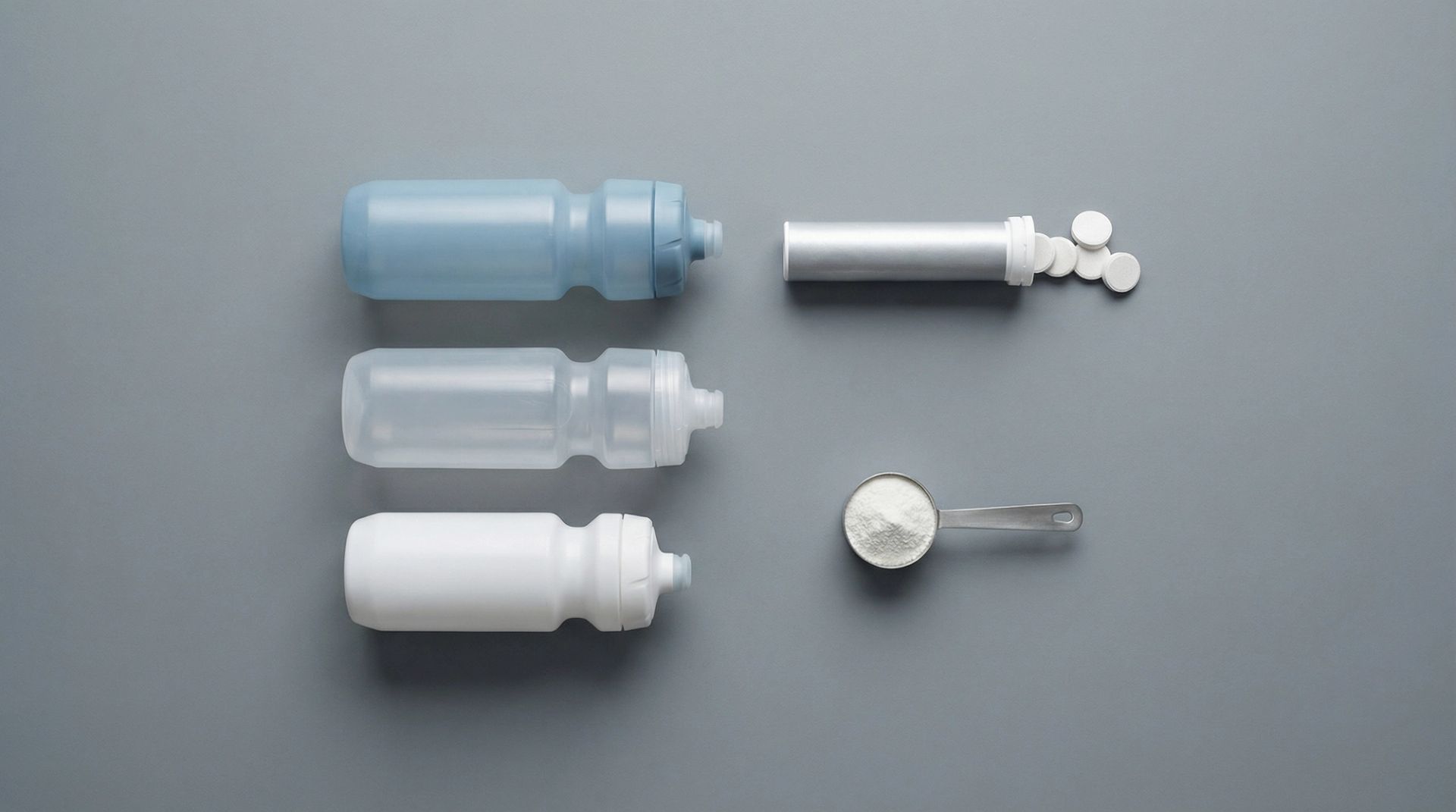
Getting hydration right can mean the difference between finishing strong and crawling home. This calculator estimates your needs based on peer-reviewed sports science studies. Adjust the sliders to match your profile and planned ride, then use the output to plan your bottles.
Methodology
This calculator estimates fluid and sodium needs based on peer-reviewed sports science research.
Sweat Rate Model
We use a base sweat rate of 11 mL/kg/h, derived from research showing relative sweat rates of 9–14.5 mL/kg/h across temperature conditions in endurance athletes.
This base rate is adjusted by three multipliers:
- Conditions (×0.7 to ×1.5): Research found sweat rates of 9.0 mL/kg/h in cool conditions (<10°C) versus 14.5 mL/kg/h in hot conditions (>20°C) – approximately 60% higher.
- Intensity (×0.7 to ×1.5): Sweat rate is linearly proportional to metabolic heat production. Studies show high-intensity exercise nearly doubles sweat output compared to low-intensity efforts.
- Individual variation (×0.65 to ×1.45): Genetics, fitness, and heat acclimatisation create significant differences between individuals.
Sodium Concentration
Sweat sodium concentration varies significantly between individuals, ranging from 230 to 2,070 mg/L (10–90 mmol/L) in research studies. The average across athletes is approximately 800–1,000 mg/L. This variation is largely genetic – some people are "salty sweaters" regardless of diet or fitness. Heat acclimatisation reduces sodium concentration over time.
Fluid Target
The calculator recommends replacing 70% of estimated sweat losses. The American College of Sports Medicine advises limiting dehydration to <2% body mass, but full replacement is impractical – gut absorption capacity peaks at approximately 1.2 L/h. Research supports 70–80% replacement as optimal for performance.
For gravel and off-road riders looking for the best on-bike hydration with a hydration pack, check out our guide to the best hydration packs in 2026.