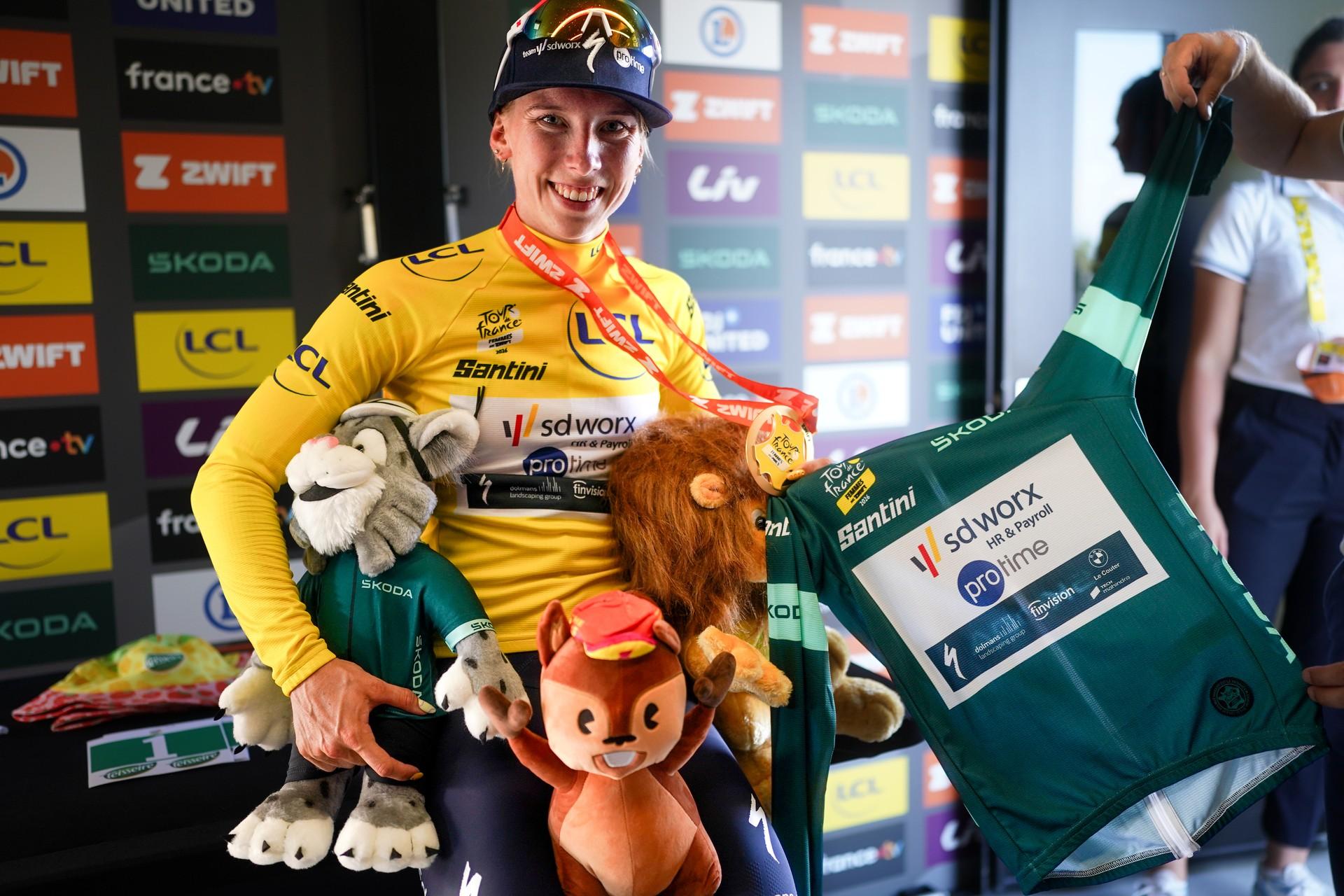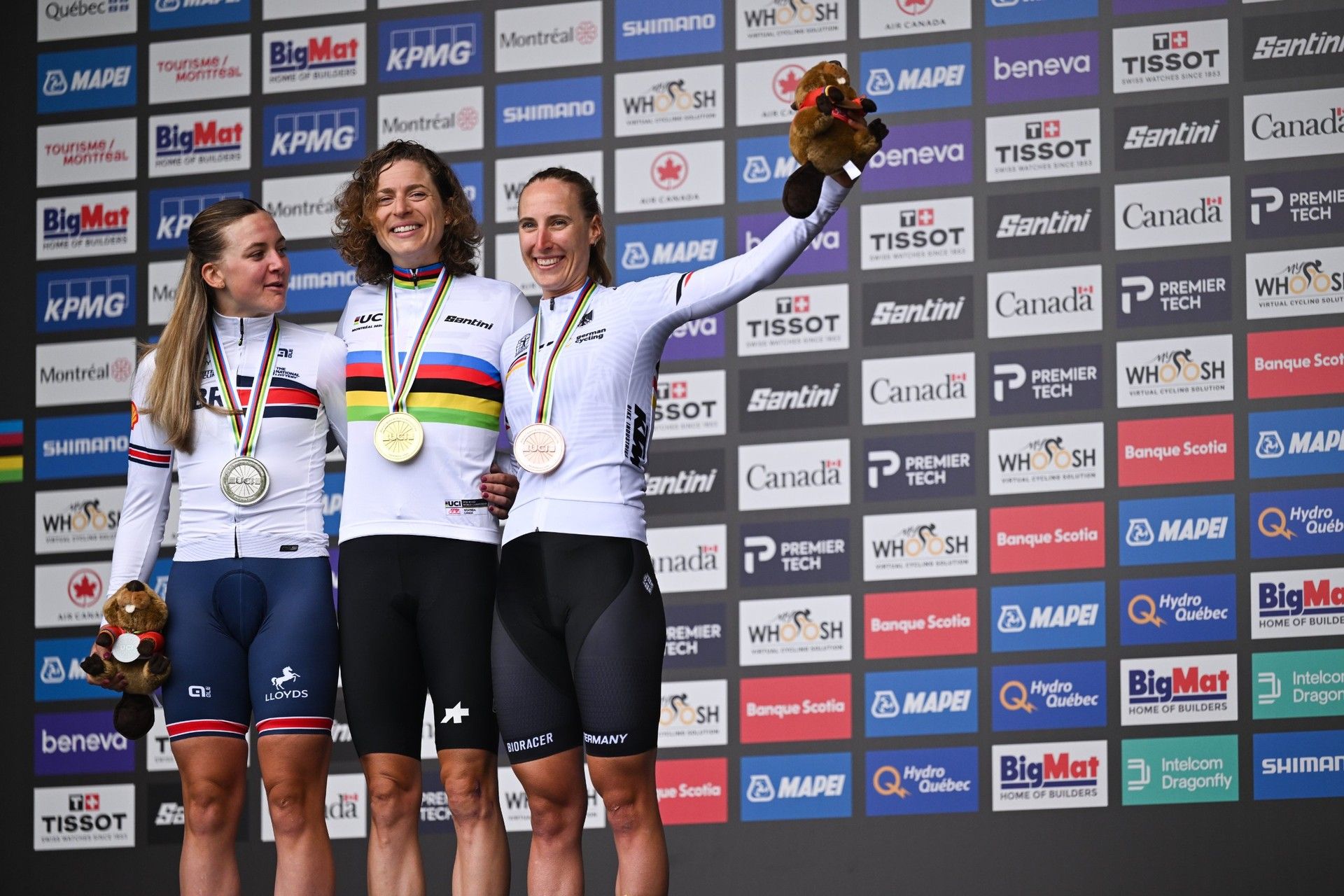
Marlen Reusser retained her world individual time trial title in Montréal on Sunday, winning on her 35th birthday despite doubts about how to pace the 39.2km course.
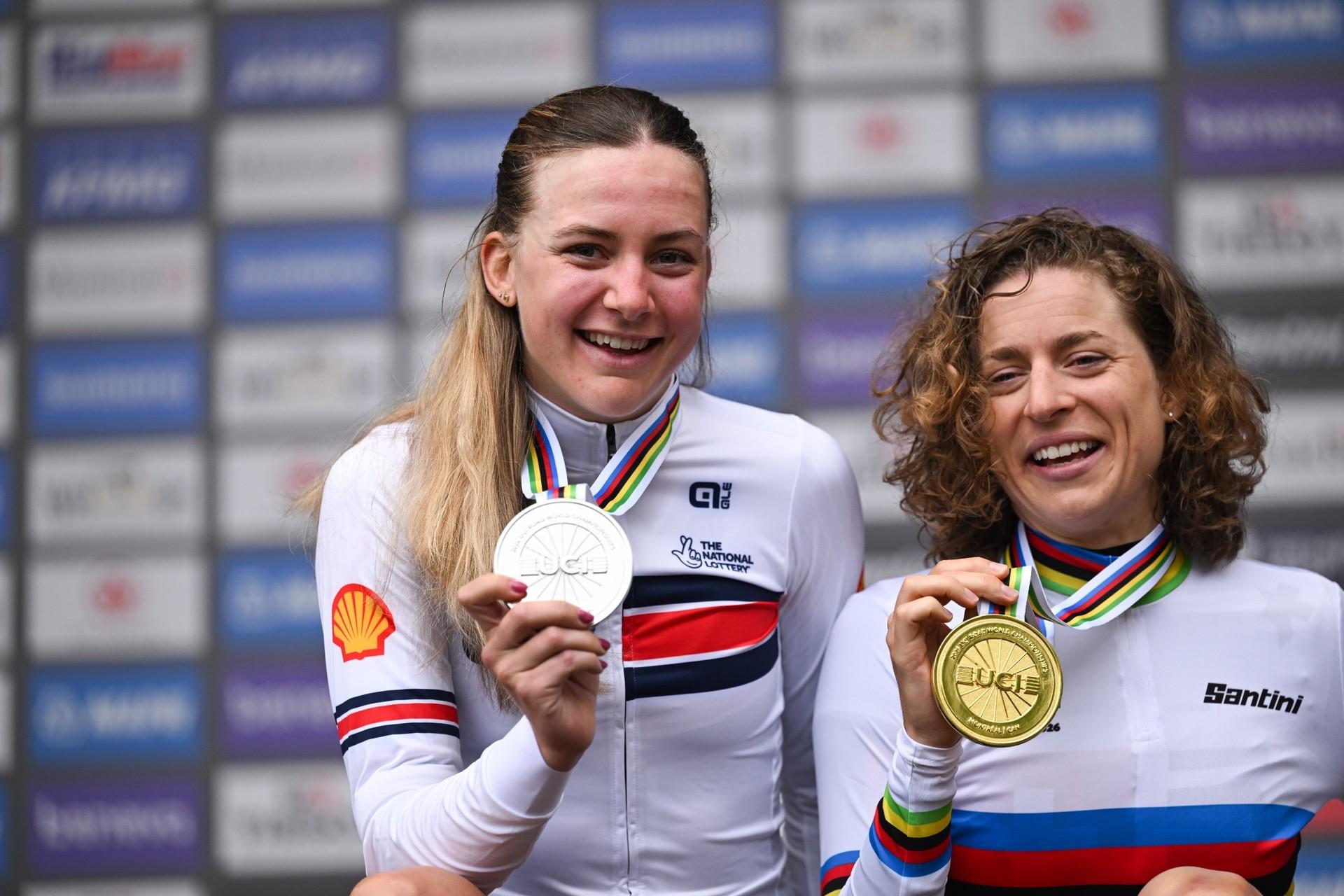
The Swiss star beat 21-year-old Zoe Bäckstedt by 40 seconds, with Franziska Koch another five seconds back in bronze. Reusser was behind Bäckstedt at the first two splits with the most technical corners at the start suiting the cyclocross star, but she then kicked on and dominated the timings at the finish.
“It’s a good present. And I also thought, I win or not, anyway, I have something to celebrate,” Reusser said in her UCI post-race interview for TV.
Results
Montréal • Sep 20 • 39.2km

| Pos | Rider | NATNationality | Time |
|---|---|---|---|
| 🥇 | Marlen REUSSER | SUI | 50:24 |
| 🥈 | Zoe BÄCKSTEDT | GBR | +0:40 |
| 🥉 | Franziska KOCH | GER | +0:45 |
| 4 | Elisa LONGO BORGHINI | ITA | +0:50 |
| 5 | Cédrine KERBAOL | FRA | +1:10 |
| 6 | Lotte KOPECKY | BEL | +1:48 |
| 7 | Antonia NIEDERMAIER | GER | +1:49 |
| 8 | Demi VOLLERING | NED | +1:50 |
| 9 | Dominika WŁODARCZYK | POL | +1:59 |
| 10 | Vittoria GUAZZINI | ITA | +2:05 |
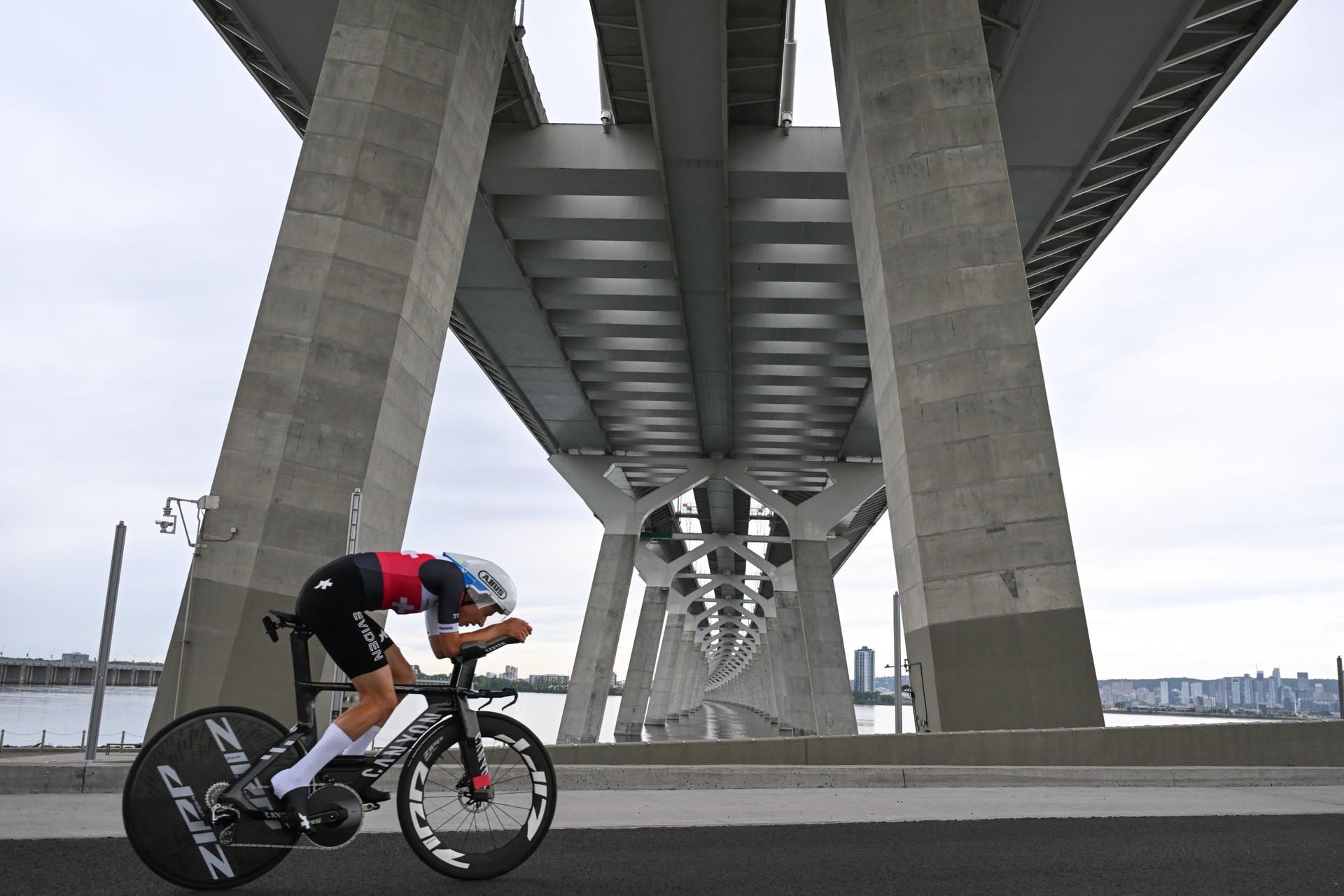
The course wasn’t easy for her to judge, with the route being the longest ever used for the women’s time trial at a World Championships. The initial technical section meant she wasn’t able to get into her pacing until heading onto the Formula 1 circuit where she could really open the taps.
“Until, till an hour ago I was not 100% sure. And also on the course I was not 100% sure, like, or not at all sure,” she said.
She deliberately rode without updates on her rivals.
“No, I didn’t have the gaps, and I was also saying, don’t give it to me,” she said. “I was even expecting that she’d be faster because the first part is quite technical, and honestly, I think some corners I don’t do so well.”
At the second check, Reusser was just three seconds down on Bäckstedt but by the third check she had jumped ahead to 14 seconds over the young Brit. But Reusser also had the motivation of catching her former teammate and now rival, Demi Vollering, who had started 90 seconds earlier.
Vollering went on to finish in eighth overall 1:50 down on Reusser despite feeling like her own ride was going very well before hearing that Reusser was about to catch her.
“I was actually happy and then I heard Marlen was coming from the back,” Vollering said in her finish interview with Cycling Pro Net.
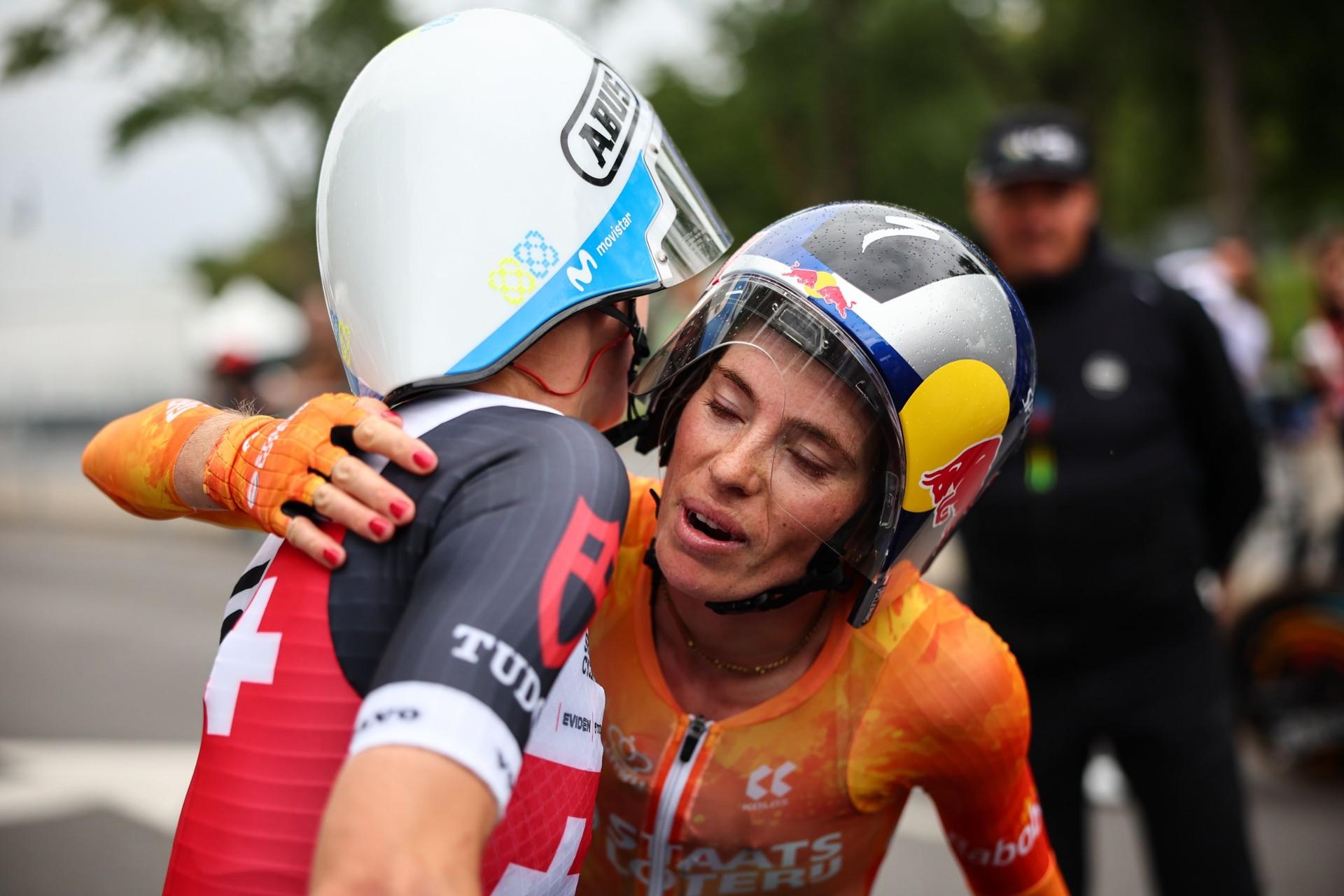
“At that moment I lost a little bit of focus,” she said. “But I tried to come back to it and finish the time trial on a good [note].”
Vollering had felt she was riding well before Reusser approached. “I had a good rhythm, for my feeling,” she said. “In the end, it was really a time trial course for the time trial specialists. I did my all, and that’s it.”
Although she had prepared for the time trial, Vollering said it had not been her only focus. “I was a bit more focused on also the road race. Now we recover from this and we look forward to the road race. It’s another day, and we see how it goes there.” The road race follows on 26 September.
Bäckstedt holds silver through a difficult finish
Bäckstedt followed her 2025 under-23 title with silver in her first elite World Championship time trial. Her plan had been to save enough energy for a distance well beyond the 20–25km efforts she usually races.
“We’re used to racing over 20, 25km, so to do 40km,” she said after the finish. “It’s quite a big difference in how you also mentally have to think about the race.”
Bäckstedt divided the route into manageable efforts. “It was quite a good course that you could break up quite a lot,” she said. “You had the first section with a lot of corners, then you had the F1 circuit, a few laps there, then the way back and a few more corners, finishing climb. It was really quite easy to break it up and be like, ‘Okay, I’ve got maybe five minutes or six minutes of riding hard here.’”
That approach helped her establish the early lead. “Pacing was just, don’t go out too hard and make sure you’ve got something left for the final,” she said.
Even so, the return from the U-turn stretched her reserves. “Don’t get me wrong, I was really tired, and from the U-turn back to the finish, this was such a hard part of the course for me,” she said. “Just being that extra bit longer than what I’m used to. But I gave it everything I could coming over that climb. I felt like I was going snail speed, like super slow.”
But Bäckstedt thinks her best performances remain on shorter efforts. “Maybe if I do a few more of them, I can learn to love it a little bit more,” she said. “But I think currently maybe 25, 30km is my prime distance.”
Koch was very consistent and got steadily faster, but Bäckstedt managed to maintain her pace and hold off the German, who has continued her superb season.
Elisa Longo Borghini finished fourth, just five seconds behind Koch. She said that the little climbs towards the finish helped her gain a lot of time in the finale compared to her rivals after being much further down at the earlier splits.
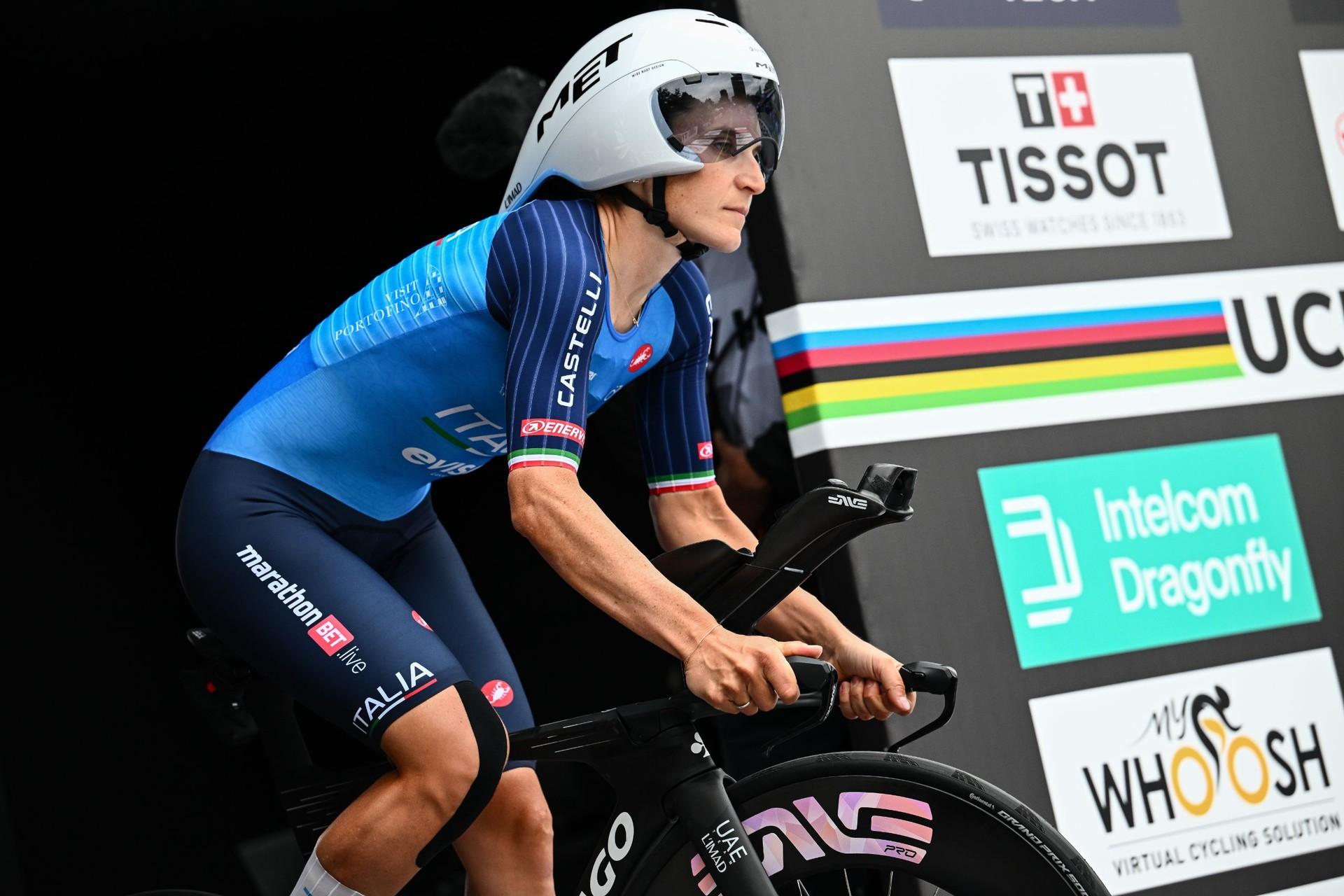
“I probably gained time on those little climbs,” she said in her mixed-zone interview. “I’m satisfied and I don’t really look at the result but at my own performance.”
Juliette Berthet had the opposite experience: she felt great on the bike and the power was there but it did not translate into time against her rivals, leaving her disappointed after a cautious opening led into a crescendo-style ride as she upped the pace towards the finish.
“I really accelerated and honestly, I felt good, and I could see that I was only losing time. So it was very hard mentally,” Berthet said after the race.
It was a huge moment for Canadian rider Olivia Baril, from Rouyn-Noranda in Quebec’s Abitibi-Témiscamingue region, who was the first home rider to start and finish her ride.
“I think I heard Olivia Baril at least 2,000 times today on the course,” she said in her finish interview. “Even during the race I was thinking, wow, what a beautiful experience.”
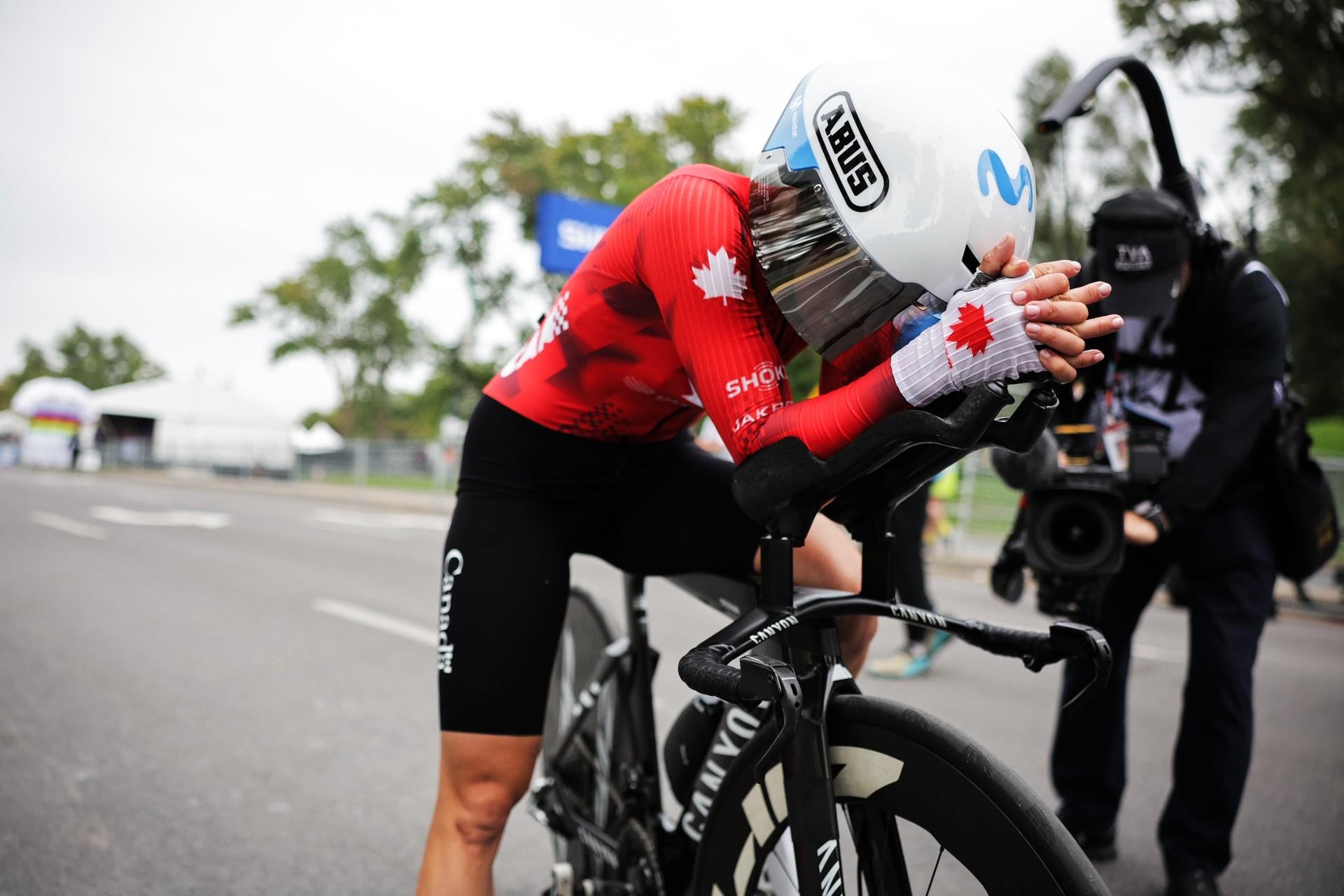
Baril said instructions from her sports director helped her stay alert through the late corners when fatigue made concentration difficult.
“At the end, I’m completely empty, but I have to keep concentrating on the turns, taking the right lines,” she said.