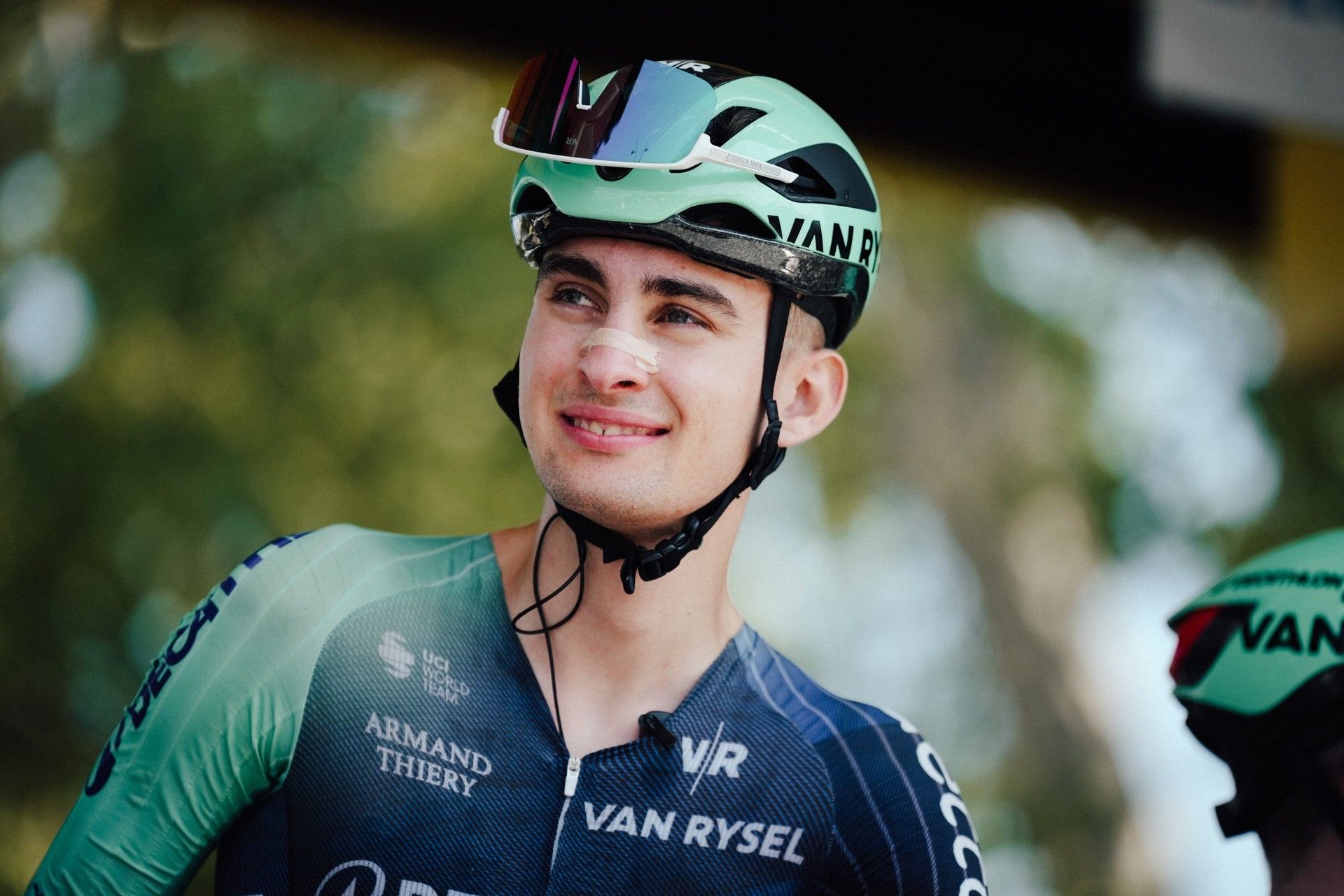
Paul Seixas (Decathlon CMA CGM Team) had just turned six when Lance Armstrong lost his seven Tour de France titles in October 2012. Now 20, and fourth overall on his Tour debut in July, Seixas says riders of his generation still have to earn back fans’ trust.
“We have to be beyond reproach. We have to do more than athletes in other sports to show we’re clean,” Seixas told GQ France when Jérémy Patrelle asked how he felt about doping coming up more often in cycling than in other sports. “We live with that burden from the past.”
Just a year before Armstrong’s first of seven Tour wins in 1999, customs officers intercepted a Festina team car that was carrying banned substances. The Tour kicked Festina out of the race. A French court later established the team’s organised doping set-up. In Armstrong’s case, 11 former teammates gave sworn testimony to the US Anti-Doping Agency, which documented a team-run doping scheme at US Postal Service.
 Photo: Morgan Bove
The Cycling Independent Reform Commission found in 2015 that past UCI leaders had given prominent riders preferential treatment and put the sport’s image first, damaging the governing body’s credibility. The UCI handed testing to the independent International Testing Agency (ITA) in 2021. In February 2026 it also put the agency in charge of handling potential anti-doping rule violations.
In two recent cases involving abnormalities in riders’ biological passports, the UCI Anti-Doping Tribunal banned Delio Fernández Cruz for four years, while Harold Tejada was provisionally suspended in a case brought by the ITA.
“There’s the World Anti-Doping Agency’s Athlete Central app,” Seixas said, giving an example of the sport’s anti-doping measures. “You have to give an hour of the day and a specific place, and a tester can turn up there at that time, every day.”
Riders in the UCI’s Registered Testing Pool file their whereabouts before the start of each quarter, including where they will stay overnight, train and race. They must update those details if plans change. Riders must be available for testing at the specified location during that hour. Testers can also turn up without notice outside that window.
“I want to live a long life!” Seixas said. “I don’t want to risk my life for my sport, even though I love it.” He believes people are starting to see a difference between the sport he races in and the one they remember. “We carry the burden of doping, but little by little we’re coming to believe that it’s no longer tolerated in cycling the way it used to be, and people understand that.”
Tadej Pogačar (UAE Team Emirates XRG) also said he trusts the vast majority of today’s peloton to race clean. “First of all, there’s a full awareness, much greater than in the past, of the harm banned substances can do to your health. Cycling is a sport and nobody wants to risk their life,” he said. He added there might always be someone who tries to cheat.
Seixas told GQ he would ride a Grand Tour in 2027 without naming which one. He has confirmed his ambitions to race the World Championships in Haute-Savoie, which will take him close to his grandparents’ home. “I’ll do whatever is best to get there at 100 per cent,” he told GQ. “But that race is a very important personal goal for me.”
Winning the Tour de France remains Seixas’s long-term ambition, so a return would be a natural choice. But his 2027 plans are still open, and he hasn’t ruled out the Giro d’Italia. “If I were Paul Seixas, I wouldn’t hesitate to ride it,” Vincenzo Nibali told La Gazzetta dello Sport, saying he thought Seixas was ready to fight for the win. Seixas is also reported to be planning a move to Andorra.