Whether you need a compact front light for a ride under street lamps or something powerful enough for dark country lanes, the right lumen count depends on where and how fast you ride. But when looking through the spec of a light, a lumen can be a fairly abstract metric – so how many do you actually need?
To put it simply, for a continuously streetlit commute, around 200–400 lumens is a useful starting point. For mixed urban and unlit routes, compare lights around 500–800 lumens. For regular road riding in complete darkness, start around 800–1,200 lumens. These are shopping ranges, though, not guarantees that a light will suit your speed or route.
A lumen measures the total visible light a lamp emits. It tells you nothing about where that light goes. A narrow beam can produce a bright central patch while leaving the road edges dark; a broader beam can illuminate more of your surroundings but lack reach.
Choose your output range from the darkest parts of your journey, then check beam performance and runtime. A light needs to show you the road far enough ahead, for as long as you intend to ride. Our best bike lights guide compares tested options for streetlit commutes and unlit roads.
Choose your lumen range by route
The amount of street lighting determines how much work your front light has to do. Under continuous street lamps, making yourself visible is a major part of its job. On an unlit lane, you also depend on it to identify the road surface ahead.
Use these overlapping ranges to narrow your search:
- Continuously streetlit commuting: around 200–400 lumens. Prioritise a controlled beam and enough battery life for your journeys between charges.
- City riding with occasional dark sections: around 300–600 lumens. Check that the beam reaches far enough through those sections, especially if they include descents.
- Mixed urban and unlit roads: around 500–800 lumens. Look for a useful high setting for dark stretches and a lower setting for illuminated roads.
- Regularly unlit road riding: around 800–1,200 lumens. Give more weight to useful reach and even coverage across the road. Faster riding may call for more output, provided the beam uses it effectively.
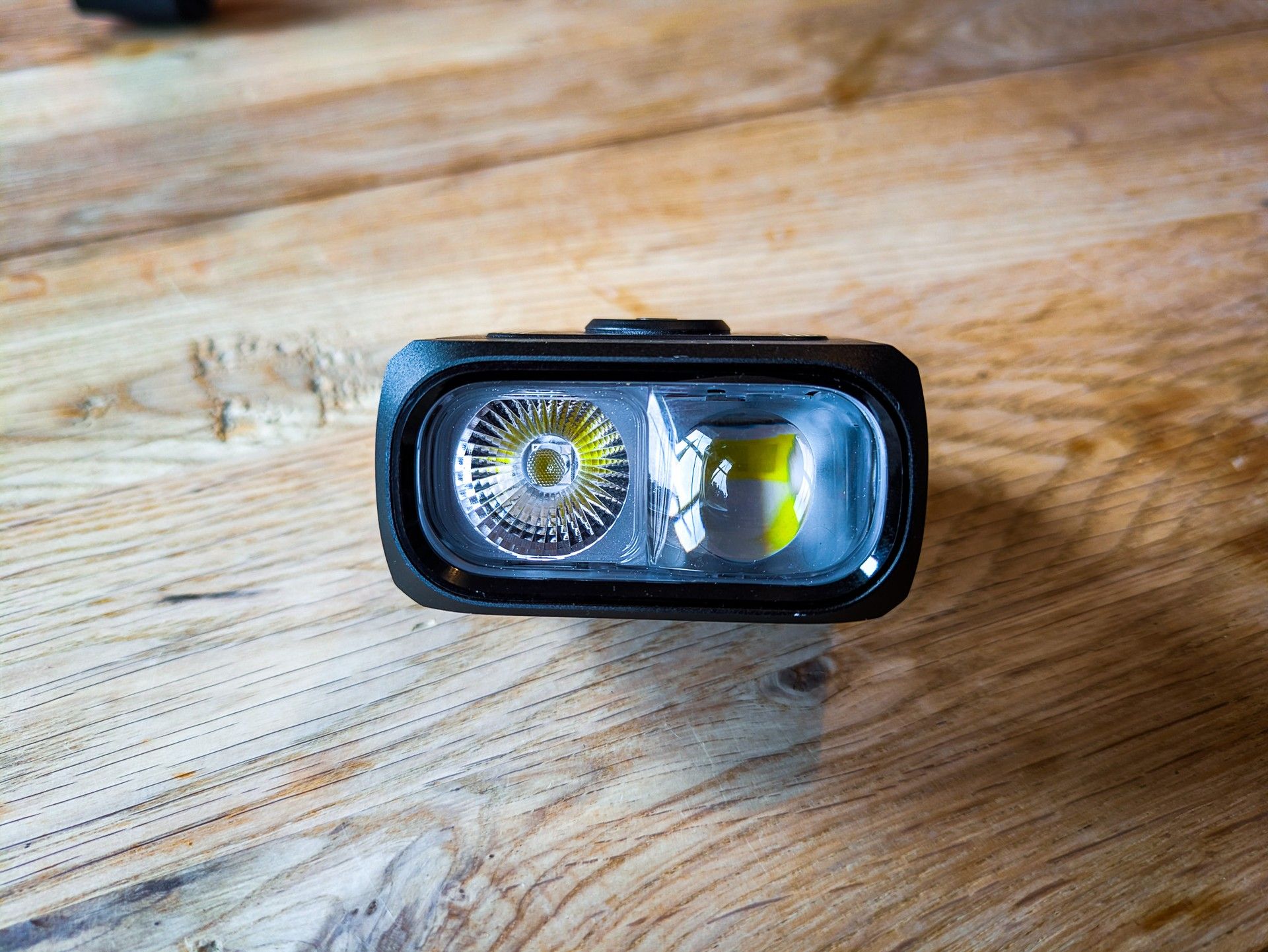
In our Magicshine URBO FL review, the 300-lumen light clearly illuminated roughly the next 10 metres. That suited streetlit riding and low-speed travel through short dark sections.
Its sharp cut-off, the boundary beyond which the beam stops illuminating the road, left the area farther ahead dark. It therefore lacked the reach for riding quickly on unlit roads, despite being useful for an illuminated commute.
For mixed routes, judge the light against the unlit stretches rather than the average conditions. A short dark section still needs sufficient illumination if you ride through it quickly. Longer stretches also require a battery that can support the higher setting without running out before you get home.
Regular night rides on country roads need a beam that lets you distinguish surface detail well ahead. Look for coverage of the verges as well as the centre of the lane, and avoid choosing solely by the brightest-looking patch near the front wheel.
Once you have a route category in mind, our best bike lights guide compares six tested front lights, from compact commuter models to more powerful options for unlit roads.
Match useful beam reach to your speed
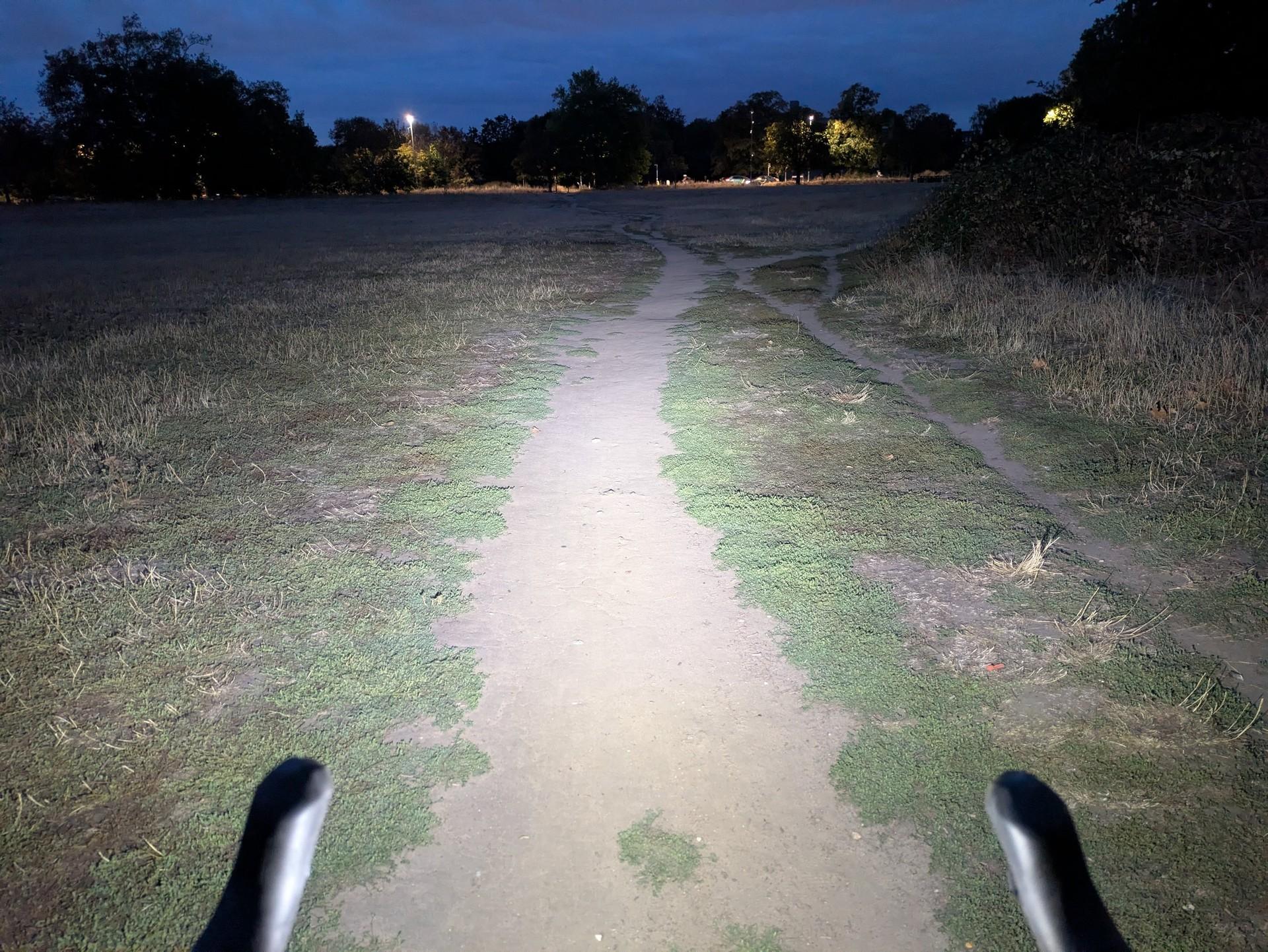
Useful beam reach is the distance at which you can identify the road surface, rather than simply detect that light reaches it. At higher speeds, you need to read the road farther ahead because you cover the illuminated distance sooner.
At 15km/h, travelling 10 metres takes about 2.4 seconds. At 30km/h, it takes about 1.2 seconds. Those figures are travel times, not stopping distances or safe-speed recommendations, but they show how quickly a short beam becomes limiting.
Manufacturer beam-distance claims do not necessarily describe usable vision. In our Towild CL1200 review, the claimed throw was up to 160 metres, but useful illumination felt closer to 20 metres. Its 1,200-lumen beam suited steady riding on familiar unlit lanes better than fast descents.
Beam photographs and road tests can help establish whether the light reaches far enough while retaining coverage at the edges. Compare photographs taken under the same conditions where possible: an isolated bright-looking image offers little basis for judging one light against another.
Lumens versus lux
Lumens measure the total visible light leaving a lamp, while lux measures how much of that light reaches a surface. A lumen rating can tell you the lamp’s overall output, but not whether its beam concentrates that light into a narrow central patch or distributes it more widely across the road.
A lux figure is only meaningful when paired with its measurement distance. A reading taken at 10 metres cannot be compared directly with one taken elsewhere, and results from different lights are most useful when the test conditions and methods are consistent.
A lower advertised lumen figure can still produce the more useful beam. Our Ravemen FR 1100 SE review found that its 1,100-lumen light delivered the best beam among the standard-sized models in the comparison, with broad, even coverage and useful depth.
Check runtime and glare before buying
Ravemen claims the FR 1100 SE lasts 1.8 hours at 1,100 lumens, compared with 3.5 hours at 500 lumens and 7.5 hours at 250 lumens. The longest advertised runtime therefore says little about suitability for a long ride in complete darkness.
For a mixed commute, switching down beneath street lamps can preserve battery for dark sections. For sustained unlit riding, choose a light whose useful mode covers the whole planned ride with reserve. Maximum output is less valuable if you cannot use it for long enough.
Around traffic, beam control deserves as much attention as power. Aim the light towards the road rather than approaching riders’ or drivers’ eyes, and reduce output when appropriate. A cut-off beam can help limit glare, although the URBO example shows that its shape still needs to provide sufficient reach.
Before relying on a new light for an unlit journey, try it on a familiar route at a cautious pace. Check whether you can identify surface defects ahead and see the road edges. If the beam feels too short at your normal speed, slow down and choose a light with better useful reach.