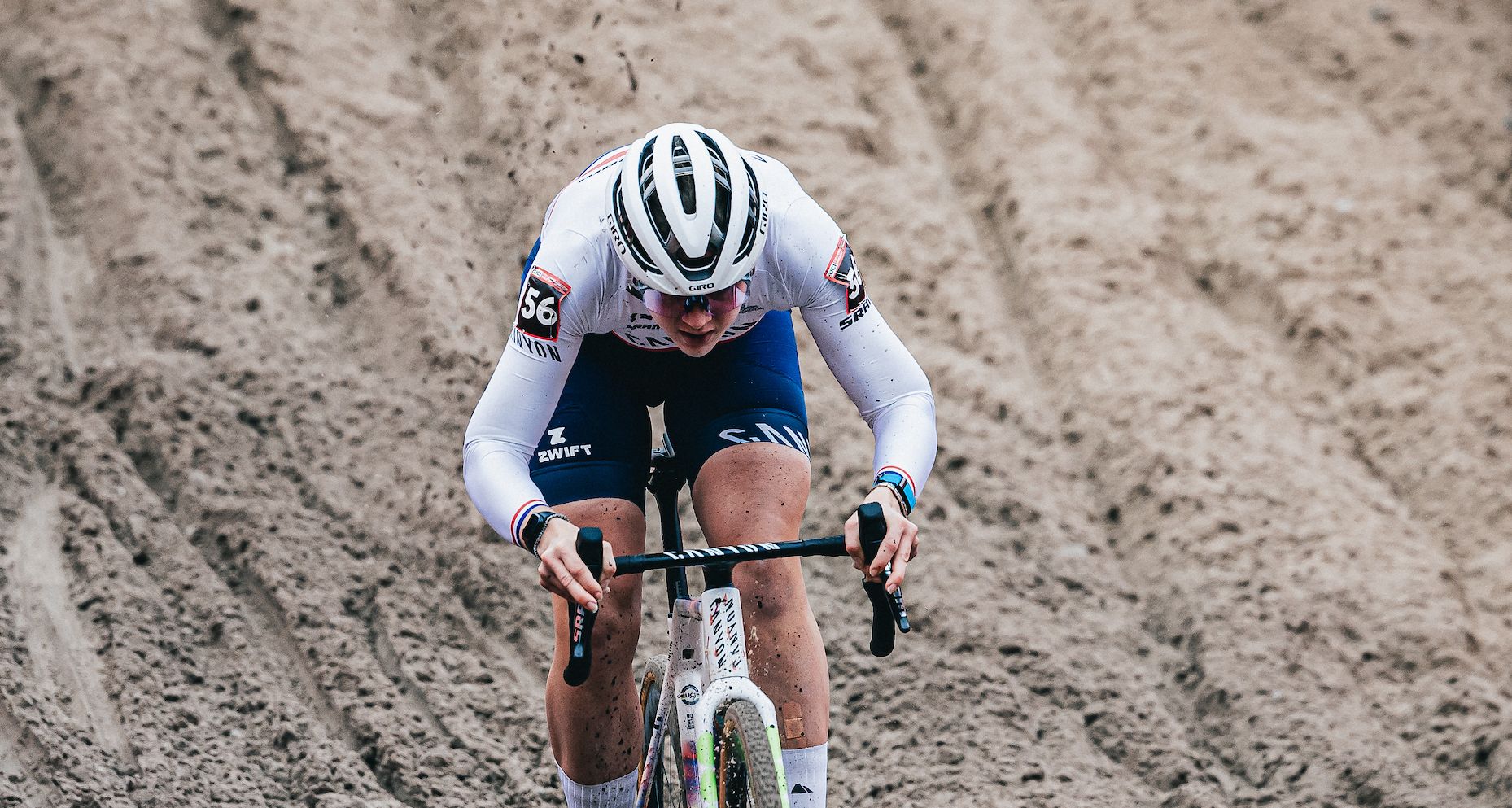
The Cyclo‑cross World Cup heads to new ground on Sunday as Terralba, on Sardinia’s west coast, makes its debut with a flat, fast and deceptively brutal sand circuit. With Thibau Nys resting after his perfect opening to the series and Mathieu van der Poel and Wout van Aert both absent, round three offers an unusual opportunity: a World Cup where the win – and a huge haul of points – is genuinely up for grabs.
In the women’s series, Lucinda Brand returns after skipping Flamanville, while overall leader Aniek van Alphen brings the momentum of her breakthrough World Cup victory. On a course built around two long sand sections and a flowing pine‑forest, this is a test of pure power, repeatability and sand technique more than climbing or raw explosivity.
The Terralba course: Sardinian sand and coastal speed
The organisers have laid out a roughly 3.1–3.4 km circuit at Marceddì, looping between the shoreline and a low pine plantation. Elevation is negligible, but the lap is far from easy.
The defining feature is sand: two extended sectors, including an early, wide straight and a newer parallel strip, will act as the principal selection points. Here, riders capable of holding high absolute power for 20–30 seconds and keeping the bike light on the front wheel can ride clear; those who mistime their entry, bog down or choose the wrong rut may be forced into running and a costly reset.
Linking the sand are fast stretches of compact coastal dirt, short asphalt connectors, and a flowing pineta section that rides almost like singletrack. The forest rewards those who can carry speed, bunny‑hop roots and keep braking minimal after maximal sand efforts. Artificial table‑top jumps, plus a pit zone passed twice each lap, complete a layout that is more about rhythm and efficiency than raw technical difficulty.
Forecasts point to mild temperatures around 12–18°C, light winds and a low chance of rain (mostly dry). In the dry, the course should run extremely fast, with lap times tumbling and mistakes punished instantly. A sprinkling of rain would leave corners greasy but could actually help the sand hold shape, creating deep ruts that reward precise handling and punish anyone fighting the bike.
Tyre choice is likely to skew towards a low‑profile tread at relatively low pressures – enough float for the sand without sacrificing rolling speed on the hardpack. With two passes through the pits, teams have scope to adjust pressures mid‑race if conditions shift.
Men: power race without its early king
With Nys having dominated Tábor and Flamanville but expected to skip Sardinia, the men’s race loses its obvious benchmark. That immediately elevates Joris Nieuwenhuis and Laurens Sweeck to co‑favourites on a circuit seemingly tailored to their profiles.
Nieuwenhuis has opened the World Cup with a podium in Tábor and a solid top‑six in Flamanville, and Terralba plays to his strengths: big sustained power, a tidy running style and the ability to hit repeated threshold efforts without losing efficiency on fast sections. If he starts well and reaches the first sand in the first three wheels, he has the engine to maintain a solo or small‑group move for half the race.
Sweeck brings arguably the deepest sand résumé in the field and has already shown this winter that his diesel still runs hot, with a second place in Tábor and a top‑five in Flamanville.
Michael Vanthourenhout is the third major pillar. After a muted Tábor but improving to seventh in Flamanville, he should relish the combination of sand and technical forest. He is unlikely to match the pure drag‑strip power of Sweeck or Nieuwenhuis, but he is excellent at dosing efforts and exploiting others’ mistakes when fatigue sets in.
Behind that trio, the race looks wide open. Niels Vandeputte and Ryan Kamp, both on the Alpecin‑Deceuninck development squad, have the punch and top‑end speed to surf groups and profit if marking between the bigger names becomes negative. Toon Aerts, back in World Cup action, is harder to gauge but historically thrives on rhythm courses where his metronomic pacing can grind down rivals.
The opening lap will be decisive: whoever survives the first sand passage in the top five is likely to form the nucleus of the front group. With little elevation to create natural choke points later on, pure drafting will matter more than usual for cyclocross; riders caught in the second line may find the door simply never reopens.
Women: Brand’s control or Van Alphen’s momentum?
The women’s field brings a fascinating mix of established sand specialists and riders on the rise.
Lucinda Brand returned to the World Cup with a commanding win in Tábor, then opted out of Flamanville. If she brings similar legs to Sardinia, she remains the reference: exceptional at holding high power in the red, one of the cleanest bike handlers in deep ruts, and tactically ruthless at controlling a race once gaps open.
Standing opposite is the series leader Aniek van Alphen, fresh from her composed solo at Flamanville in which she rode the fast course almost like a time trial previewed here and then delivered in the race itself. Terralba demands similar qualities: aerodynamic discipline on fast straights, the ability to repeat near‑threshold efforts through sand, and the confidence to commit early if the group behind hesitates.
Ceylin del Carmen Alvarado, building back from a knee issue, showed in Flamanville that her trajectory is upward with a podium ride. Technically she may be the sharpest in this field, especially in the forest section where small mistakes will accumulate.
Denise Betsema is the other major sand card. Historically devastating on sandy circuits, she has not yet found peak consistency this winter, but Terralba offers exactly the terrain where she can ride herself into form. Manon Bakker, increasingly reliable at World Cup level, and young talents like Leonie Bentveld and Shirin van Anrooij round out a deep second tier.
Expect Brand and Alvarado to be aggressive from lap one, trying to drop purer rouleurs before they can settle into a rhythm. Van Alphen, by contrast, may prefer to ride steadier and use the forest to limit any damage before unleashing her power on the hardpack and finish straight.
Wildcards, conditions and race scenarios
Because Terralba is a new venue, there is no previous race script to lean on. Early reconnaissance and warm‑up laps will therefore be unusually important. Riders and mechanics will need to decide quickly whether the sand is faster to ride or run, and how much risk to take on the table‑tops and cambers when chasing seconds.
If the forecast light rain materialises, we may see a strange split: sand sectors becoming marginally easier as they firm, while the compact dirt and grass turns treacherous. In that scenario, technically confident riders who are happy to lean the bike hard – Vanthourenhout and Alvarado in particular – gain extra value.
Conversely, in fully dry conditions, pure wattage may dominate, favouring riders like Nieuwenhuis, Sweeck, Brand and Van Alphen, who can push long, flat efforts deep into the red without the course ever offering real recovery.
Predictions
Men
1. Joris Nieuwenhuis – combines sand power with the smoothness to exploit a flat, fast lap; if he starts well he is the hardest to dislodge.
2. Laurens Sweeck – superior sand craft keeps him in the fight; may lose out only if the race settles into repeated high‑speed drags on asphalt.
3. Michael Vanthourenhout – profits from others’ mistakes in the forest and in rutted sand; a late counter‑attack specialist if marking between the top two stalls.
Women
1. Lucinda Brand – Tábor form plus this terrain equals favourite status; her ability to ride long sand sections under pressure should decide it.
2. Aniek van Alphen – series leader rides a high, steady pace that can blunt attacks; if she exits the final sand in contact, her sustained power could still bring the win.
3. Ceylin del Carmen Alvarado – technical mastery keeps her in contention even if the pure wattage is not yet at Brand’s level; a small‑group sprint for second looks likely.
On a new Sardinian stage with no historical template, Terralba promises to be that rare World Cup: one where ingenuity in the sand and the courage to commit early can reshape the pecking order.
Cover picture credit: Alex Whitehead/SWpix.com

