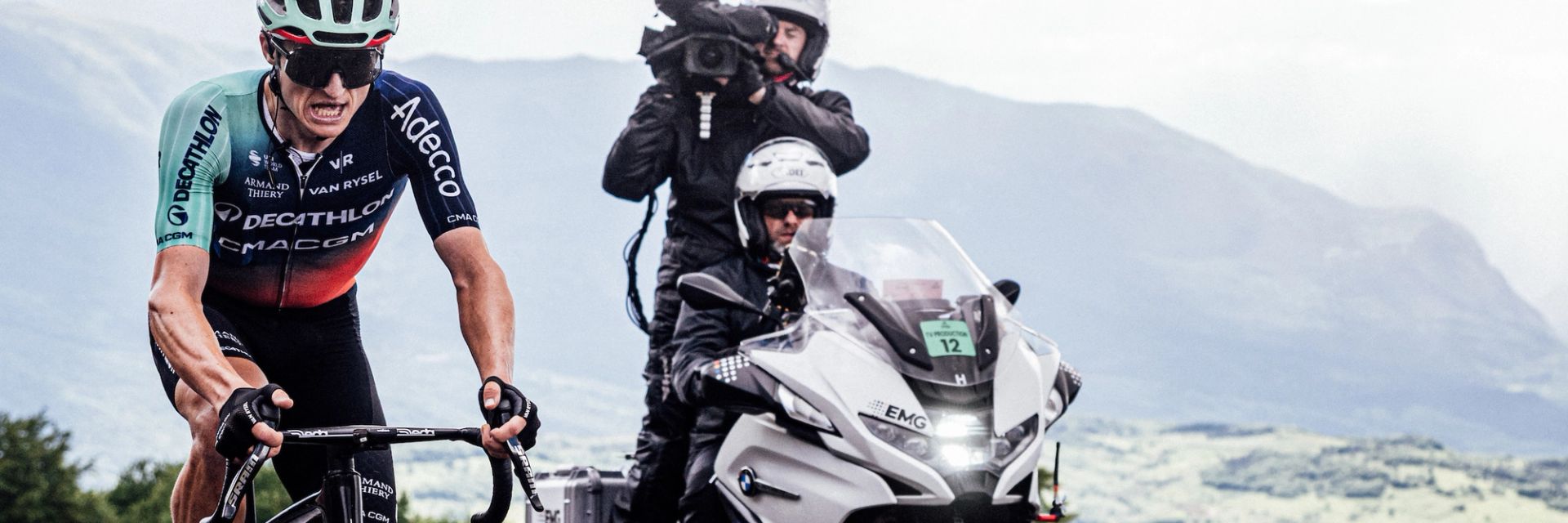
Decathlon CMA CGM Team gave Felix Gall video footage of every descent at the 2026 Giro d’Italia and told him before the race that four of them would require full commitment, sports director Luke Rowe has said.
Speaking on the Watts Occurring podcast on November 4, Rowe said his fellow sports director Luke Roberts led the team's Giro campaign and how key he was in helping the Austrian, who has had trouble on descents in the past.
"Luke Roberts was leading the Giro and he's fantastic at this type of thing. He's got many a rider onto a podium. He's won the Giro with Dumoulin back in the day," Rowe said.
As well as the footage, they made sure that Gall did recons on a few of the descents as well as the climbs so that he could get his eye in and have more of an idea of what is needed on the downhills.
"We have video of all the descents. I think he rode a couple of them. I think also just being from the start, from the outset, just going on these days, on these four descents, you're going to have to descend full," he said. "And it's just a mentality from the get-go. Prepare for it. Don't be surprised when you get to the top of the mountain. It might be wet. You got to go down the other side and you got to go fast."
In the end, Gall was well beaten by Jonas Vingegaard (Visma | Lease a Bike) with a gap of 5:22 between them on the final podium in Rome on May 31. However, it was his first Grand Tour podium and a marked improvement on previous GC attempts. He did not win a stage but finished second five times, at Blockhaus, Corno alle Scale, Pila, Carì and Piancavallo, all behind Vingegaard.
"Five times he was second on the stage. So, I think he's second in the race overall and I think he was genuinely the second best. It's not always the case," Rowe said. "It was well executed throughout really from Felix."
Gall stayed 13 seconds behind Vingegaard on Blockhaus on stage 7 by riding his own pace, which moved him into third overall. Two days later his team controlled the stage to Corno alle Scale for him, and when he attacked on the final climb only Vingegaard could follow. The 42km time trial from Viareggio to Massa cost him 1:22 to Vingegaard and dropped him to fourth. He returned to third at Pila on stage 14 and moved into second at Carì on stage 16, keeping that place to Rome.
In the team's statement after the race, Roberts said Gall's commitment to the team's plans had been decisive. "Felix has his strengths, but also his weaknesses, just like any rider," he said. "The way Felix committed to our plans, and the way he gave it his all allowed us to secure this second-place finish."
Gall went on to finish third at the Vuelta a España, giving him two Grand Tour podiums in 2026. He also won the overall title at the Vuelta a Burgos, where he won a stage. It was easily his best ever season. He will join Lidl-Trek in 2027 on a three-year contract running until the end of 2029, which almost feels like a shame.
Earlier in the season, Gall was dropped on a key descent in the Volta a Catalunya thanks to the tempo being set by Remco Evenepoel (Red Bull-Bora-Hansgrohe) as he looked to set up Florian Lipowitz. The stage to Queralt was eventually won by Vingegaard again, but Gall lost over two minutes to his closest rivals that day and slipped to sixth from second after showing he was one of the best climbers on an earlier summit finish.
He goes from Decathlon CMA CGM, where only Paul Seixas sat above him in the hierarchy, to Lidl-Trek where he will have to fight for leadership against Juan Ayuso, Derek Gee-West, Mattias Skjelmose, along with the big name sprinters such as Jonathan Milan and Mads Pedersen.
What comes next remains to be seen, but the preparation at Decathlon helped Gall build the confidence behind his best season yet.