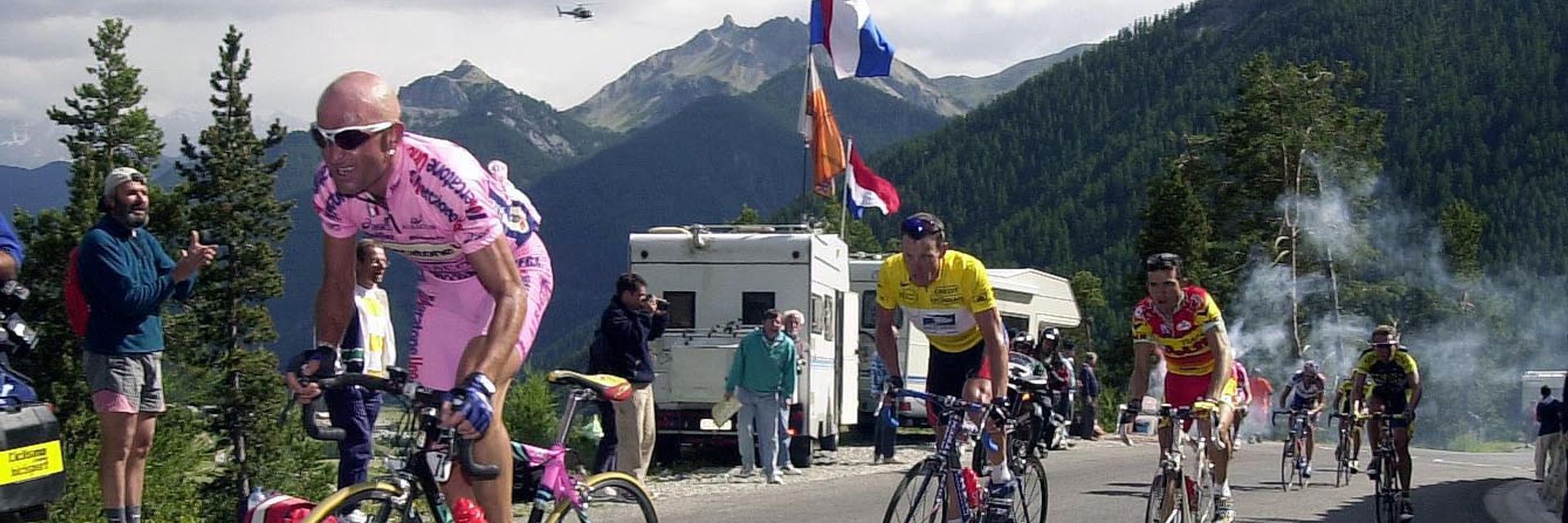
Tadej Pogačar finally did what cycling had spent three decades waiting to see: he climbed Alpe d'Huez faster than Marco Pantani. His 35:27 on July 24 cut 83 seconds from Pantani's 1995 time over the same 13.8km course.
Alpe d'Huez has a special place in pro cycling and the broader landscape of cycling performance. Millions of riders have climbed it, and its timed ascent has become a benchmark for historic cycling power. Only a decade ago, 40 minutes seemed like the standard for Tour de France climbing dominance, and Pantani's record was confined to fantasy.
When it comes to comparative performances, the stopwatch alone cannot tell us which was the stronger climb. Pogačar had the benefit of three decades of development in tyres, drivetrains, aerodynamics and bike design, advantages Pantani never had.
So we built a model to ask a different question: what might happen if both riders produced the same performance, but did it on 2026 equipment?
Below is our interactive visualisation modelling the fastest times on the ascent of the Alpe, normalised for equipment. It's interactive – you can tweak Pantani's projected bike weight (we'll explain that later).
We have not normalised for conditions such as temperature and wind speed, as collecting reliable detailed weather data for all major ascents is not possible.
After adjusting Pantani's 36:50 for the equipment difference, the model puts him at 35:13, 14 seconds ahead of Pogačar's 35:27.
The same adjustment puts another of Pantani's performances ahead of Pogačar. His 1997 ascent falls from a recorded 36:55 to 35:17, while his 1994 ride adjusts from 37:15 to 35:37, ten seconds behind Pogačar.
Jan Ullrich's 1997 performance is next at 36:03 after adjustment. Alex Zülle, Miguel Induráin and Bjarne Riis sit at 36:31, 36:32 and 36:33 respectively, while Lance Armstrong's 2004 time adjusts to 36:35. Armstrong's result was expunged in 2012, but we’ve kept his time in the comparison as his climbing performance remains a key part of cycling's history.
Below we delve into our methodology, and its gaps. Our model depends on weight estimates of equipment that was rarely weighed or tested at the time. But the exercise demonstrates why comparing climbing times across eras is more complicated than lining up two numbers on a results sheet.
Where the differences come from
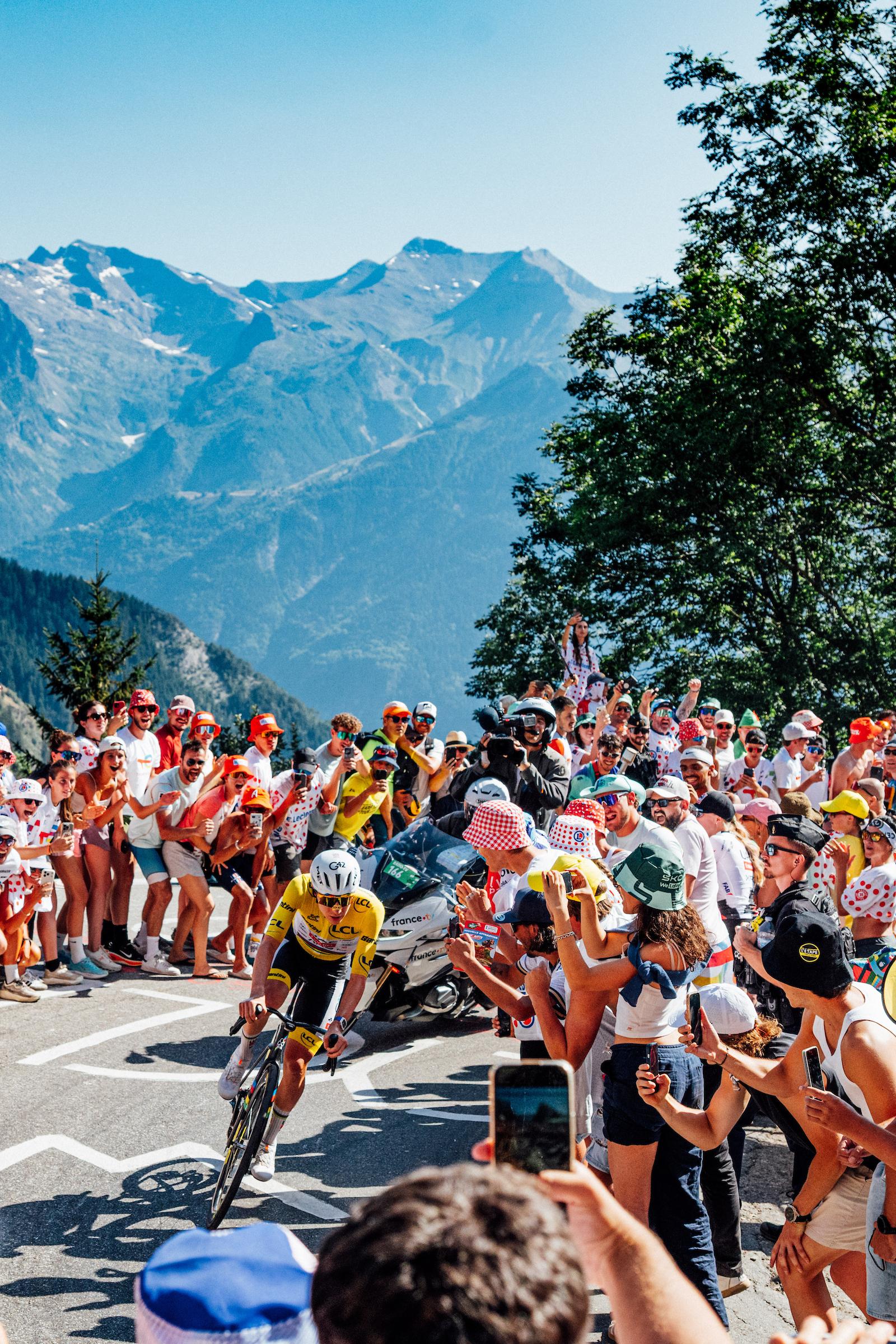
Photo credit: Zac Williams/SWpix.com
The adjustment covers bike and kit mass, rolling resistance, aerodynamics and drivetrain efficiency. Every rider is then measured against the same 2026 reference specification.
The model's estimated 97-second gain from 1995 to 2026 comes from:
- Improved drivetrain efficiency contributes 46.6 seconds.
- Lower rolling resistance from tyres and road surface contributes 22.8 seconds.
- Aerodynamic changes contribute 16.8 seconds.
- Lower assumed bike mass contributes 16.2 seconds.
- Additional modern kit mass, including a mandatory helmet, costs five seconds.
Combined, the equipment gains wipe out Pogačar’s 83-second advantage, with 14 seconds to spare.
How the equipment adjustment works
The model uses the road-cycling power equation published by James Martin and colleagues in 1998, validated against direct SRM measurements. It works backwards from each recorded time to estimate the power required with the rider's mass and era-specific equipment, then holds that power constant and recalculates the time on a common 2026 specification.
The model's assumptions are:
- Pantani's bike weighed 7.6kg, against 6.95kg for the 2026 reference bike.
- Drivetrain efficiency improved from 95.7% in 1995 to 98.2% in 2026.
- The rolling-resistance coefficient fell from 0.0043 to 0.0031, reflecting wider tyres, lower pressures and changes in road surface.
- The aerodynamic coefficient fell by about 9% through changes in clothing, wheels, frame design and riding position.
- Pantani carried 1.1kg of kit, while the 2026 reference is 1.3kg because it includes a helmet.
- Air density is calculated at the climb's mean elevation, and frontal area is scaled to each rider's size.
Each uncertain input is varied across a plausible range in the simulations rather than treated as known.
By this model, Pogačar produces a modelled 448 watts, or 6.78W/kg, and Pantani 399 watts, or 6.99W/kg. These are estimates, not power-meter readings but match up fairly well with reported numbers elsewhere.
To reflect the uncertain inputs, the model runs 8,000 simulations per ride. Pantani's 1995 ascent lands in a 90% range of 34:43 to 35:40, and comes out ahead of Pogačar in 81% of those simulations. That makes Pantani the likelier winner under the model, not the certain one.
One bike-weight assumption could reverse the result
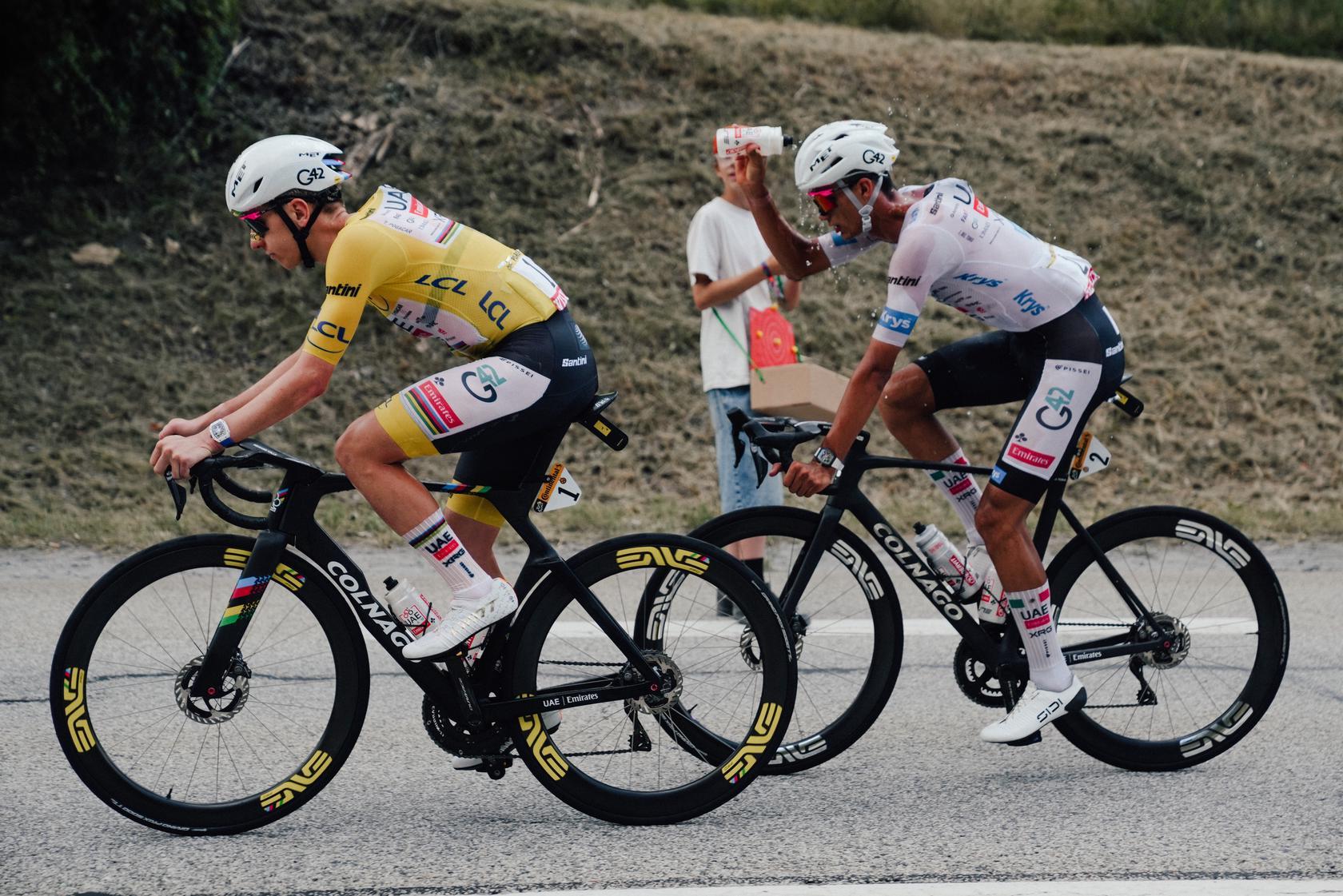
Photo credit: Thomas Maheux/ ASO
There is no reliable figure for the weight of Pantani's 1995 bike. The UCI's 6.8kg minimum did not arrive until 2000, though hugely lighter bikes were rare in the pre-carbon era, and 1990s climbing bikes could be lighter than modern aero machines. A 1998 Bianchi Mega Pro XL associated with Pantani has been weighed at about 6.96kg with pedals and a bottle cage, while BikeRadar weighed Pogačar's 2026 Colnago Y1Rs at 7.25kg.
The model uses 7.6kg for Pantani’s 1995 bike but allows a range from 6.9kg to 8.6kg. If it weighed 7.01kg, his adjusted time exactly matches Pogačar's 35:27. A heavier bike assumption puts Pantani ahead, while a lighter one leaves Pogačar in front. That's why this part of the model is adjustable – at the bottom of our infographic you're able to move a toggle for Pantani's bike weight between the lowest and highest estimate.
Nutrition has been left out of the headline result. A rider in 1995 may have consumed about 40g of carbohydrate per hour, compared with 90 to 120g in 2026. Modelling that would have required changes to the assumed power output which become physiologically complex. One could also argue that the likely effect concerns power retained after several hours rather than fuel for a 36-minute effort.
Pantani reached the climb in 1995 after 149km and about 2,900 metres of earlier climbing, including the Madeleine and Croix de Fer. Pogačar covered 114km and 2,280 metres of climbing before reaching the Alpe. Modern fuelling would probably improve Pantani's adjusted performance, but we didn't feel we could produce a model that would support a robust estimate.
The model also cannot adjust for doping, wind, drafting or differences in race conditions. Holding physiology constant is a generous assumption for an era when EPO remained undetectable.
Pantani's 1995 ascent comes out faster once the central equipment assumptions are applied, but Pogačar retains the record in real terms.
The advancements in technology and training don't show any signs of slowing, though, so time will tell how long even Pantani's theoretical record lasts.