The 2027 Tour de France Femmes will be entertaining because this race always is. The riders know how to put on a show. But the route unveiled in Paris on Thursday, October 22, gives them less to work with than the course they raced so well in August.
The nine stages cover 1,156km and 17,665m of climbing, running from Leeds in West Yorkshire on July 30 to the summit of Puy de Dôme on August 7. Four stages are classed as flat and the only mountain ranges are the Pennines and the Massif Central.
The missing Alps and Pyrenees matter less than where the climbing sits. After a mostly flat day, stage 7 ends with the race's first summit finish, with Côte du Point du Jour (2.1km at 8.6%) and La Loge des Gardes (6.7km at 7.1%) packed into the finale. Stage 8 has six categorised climbs, 3,000m of ascent and the race's highest point, the 1,451m Col de la Croix Saint-Robert, but it descends to the finish in Clermont-Ferrand. The organiser said that "the queen of the 2027 edition will only emerge from the shadows inside the final kilometre of the ninth and final stage".
- 1
- 2
- 3
- 4
- 5
- 6
- 7
- 8
- 9
Tour de France Femmes 2027
A long way down to the mountains
Each line traces the height of the ground. As the race heads south, the land it reaches lifts.
Stages 1 and 2 · The Pennines
England saves its hills for one day
The opener's last climb comes 20km out, so it ends in a sprint. The next day crosses the Peak District, with its steepest wall saved for Sheffield.
Jenkin Road 800m at 10.8%, 6km from the line
Stages 3 and 4 · London to Calais
Against the clock, then across the water
18km of team time trial ends on The Mall. In France the coast offers one real climb, a long way from the finish.
Cap Blanc-Nez roughly 12km from Calais
Stages 5 and 6 · South to Bourges
A sting, then nothing
Stage 5 hides six short, steep climbs in its last 50km. Then the land goes flat all the way to Bourges.
Stage 6 no categorised climbs, 820m of climbing
Stage 7 · Nevers to La Loge des Gardes
Day seven, and finally a summit
After six days, the ground under the race starts to climb.
Côte du Point du Jour 2.1km at 8.6%
La Loge des Gardes 6.7km at 7.1%
Stage 8 · Into the volcanoes
The roof of the race, then a long way down
Six categorised climbs over the high ground, before the road falls back to Clermont-Ferrand.
About 3,000m of climbing
1,451m Col de la Croix Saint-Robert
Stage 9 · Puy de Dôme
The longest day ends on the steepest ground
170km and eight climbs before the volcano itself, 11.3km at 7.8%.
3,840m of climbing
About 12% for the last 4km
The whole route
Two days hold nearly 40% of the climbing
17,665m in all. Stage 8 is given as about 3,000m, so the split is approximate.
Lines show ground height, greatly exaggerated. Route lines join starts, named climbs and finishes, not the roads raced. Dashes are transfers.
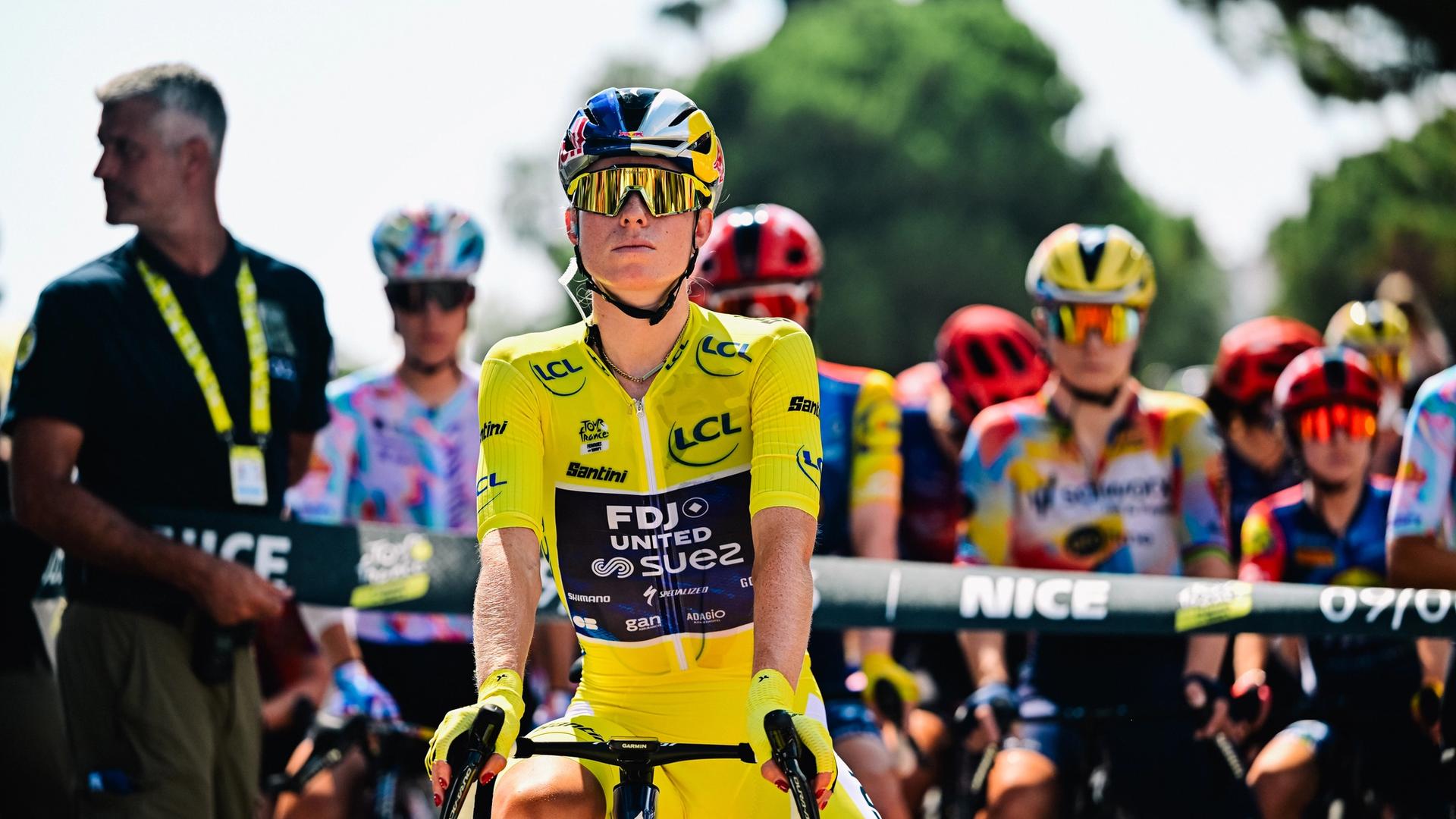
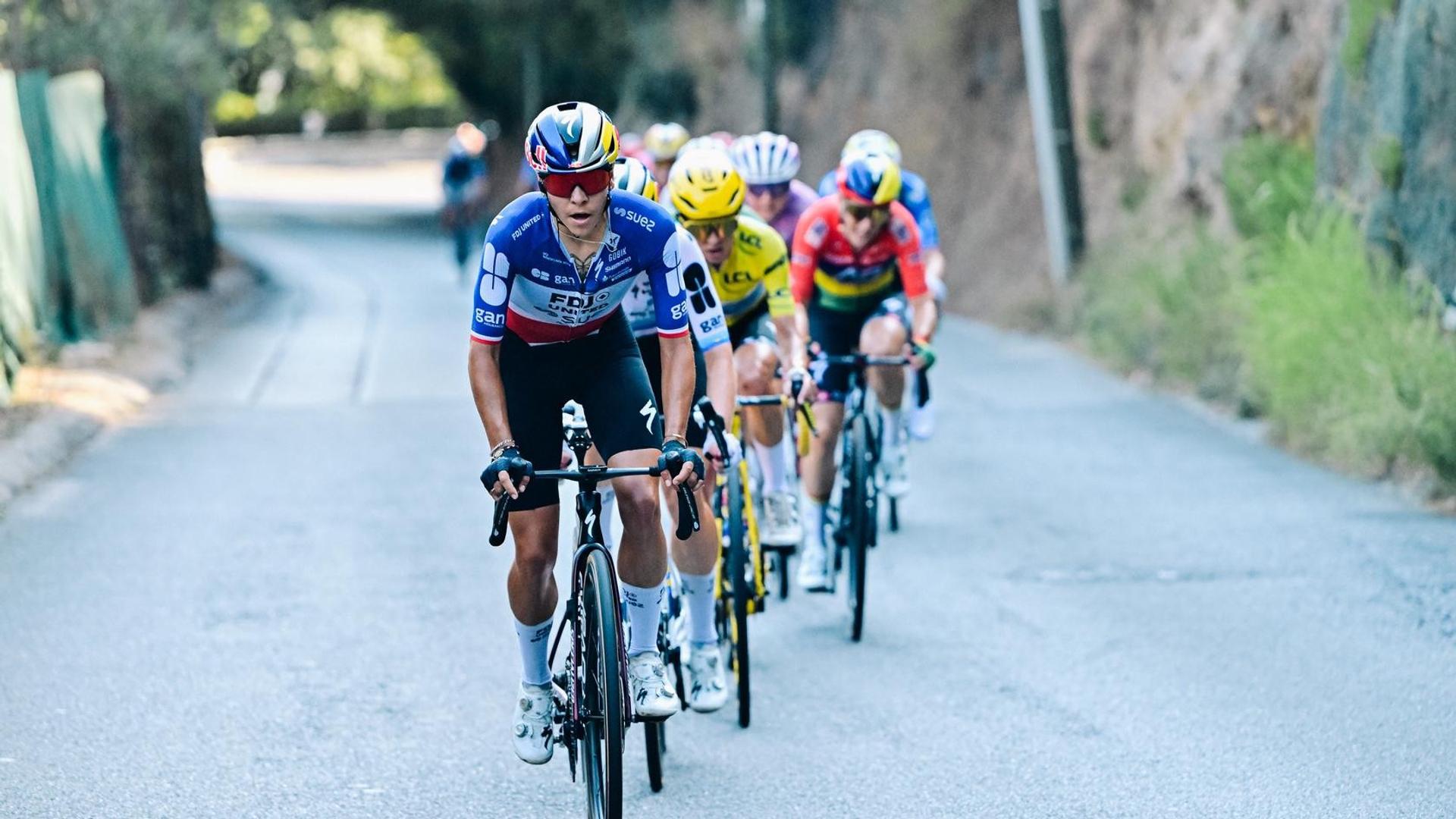
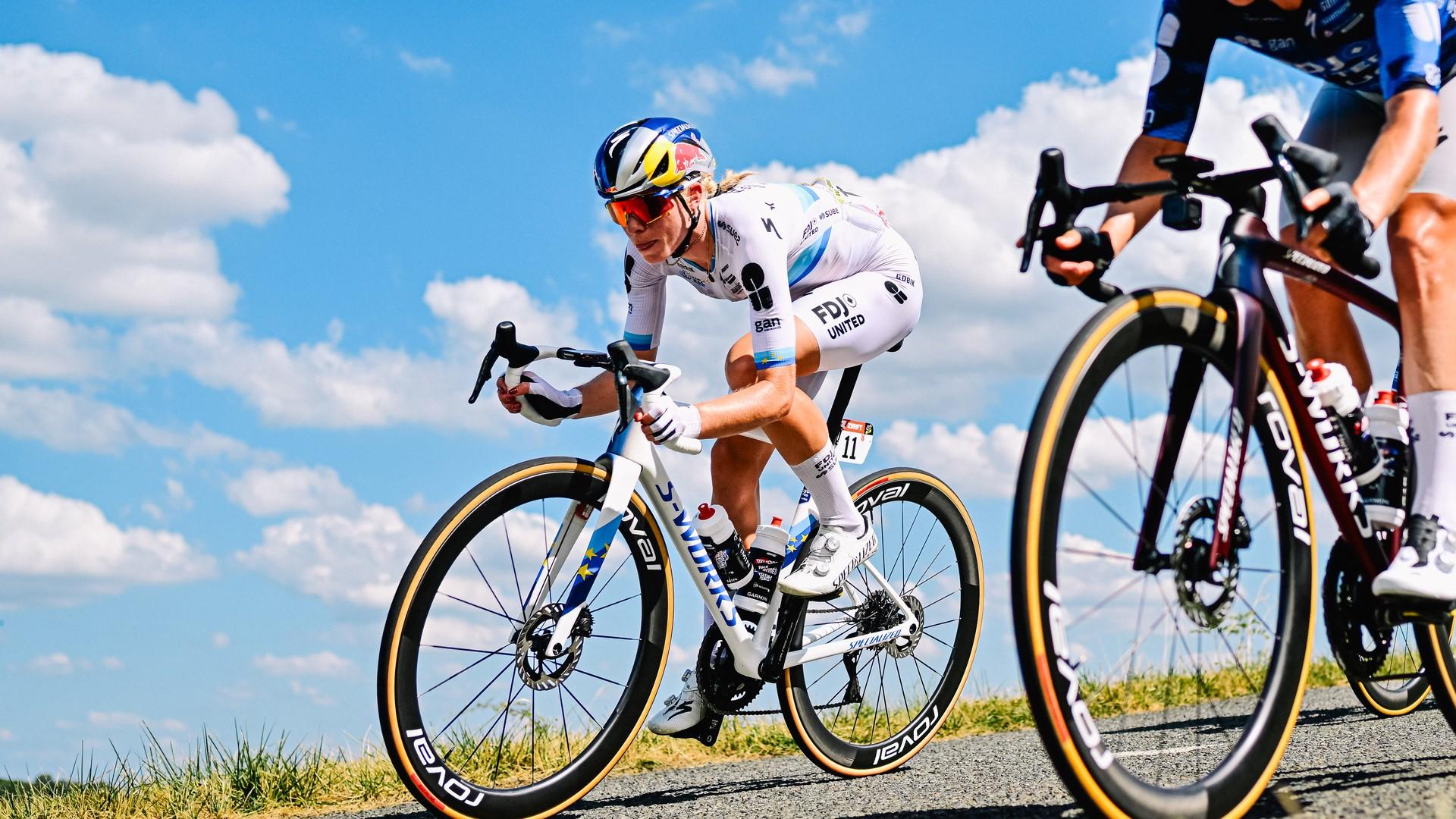
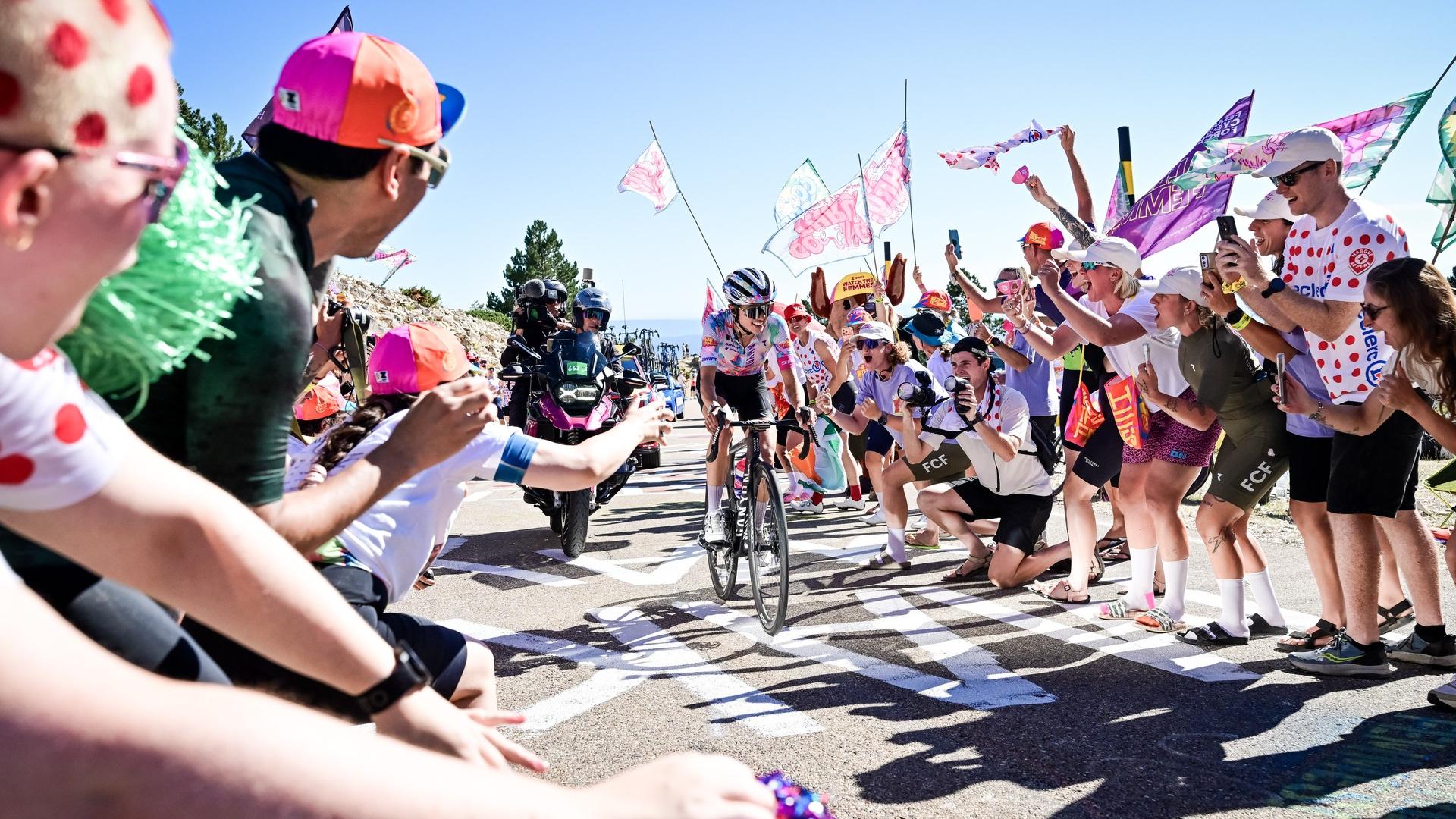
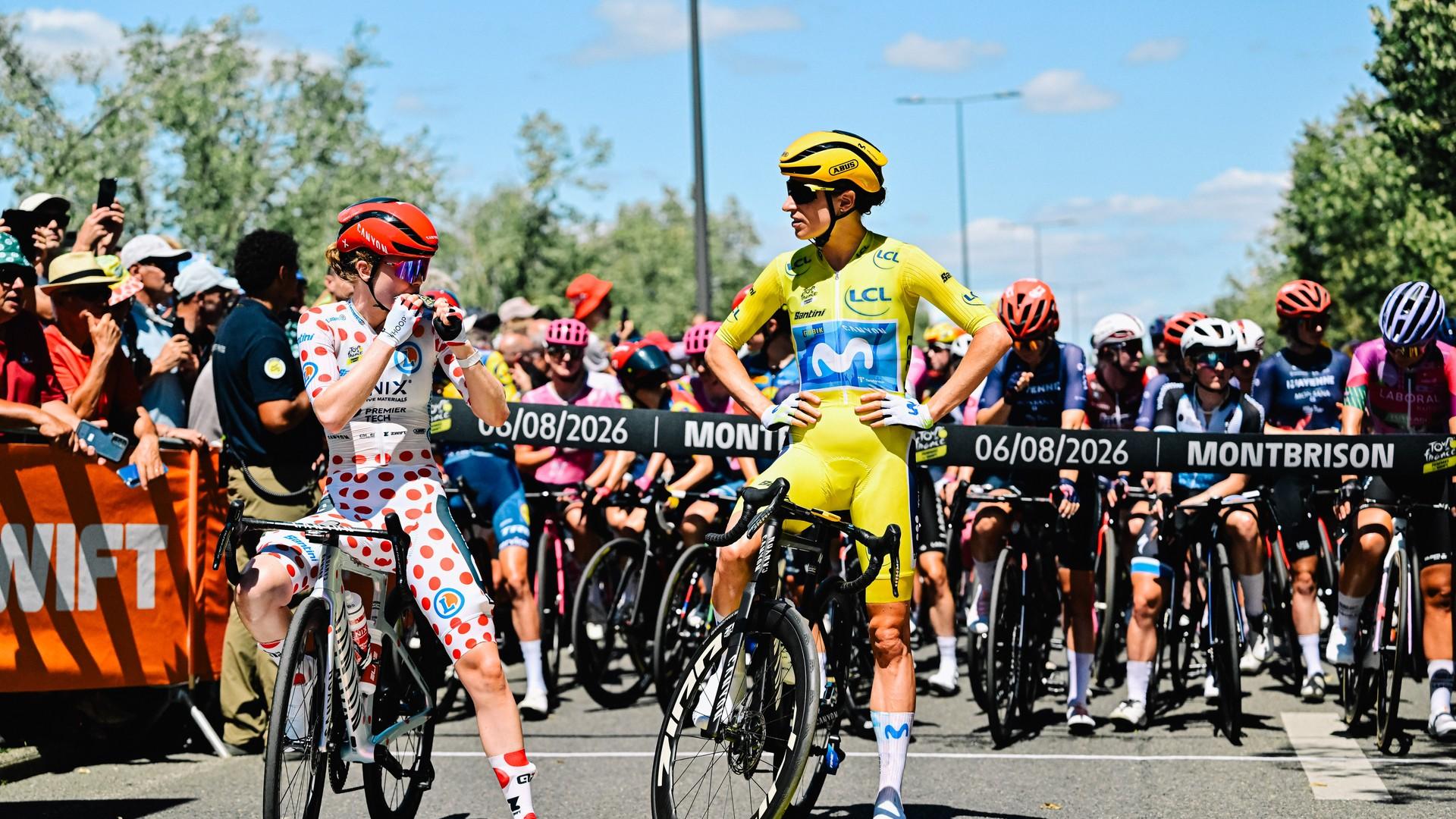
The 2026 race showed what more varied terrain can produce. Demi Vollering (FDJ United-Suez) and Kasia Niewiadoma-Phinney (Canyon//SRAM) split the favourites on Mont Brouilly. Niewiadoma-Phinney then attacked 10km from the Ventoux summit and won by 1:16. Vollering took yellow with an attack on the 450m Chemin de l'Arieta into Nice and sealed the Tour by 1:18 over four ascents of Col d'Èze. Five riders wore yellow, a record for the race in its new guise.
Route
9 Stages • 1,156km total

| Stage | Date | Route | Distance | Type |
|---|---|---|---|---|
| 1 | - | Leeds – Manchester | 86 km | Flat |
| 2 | - | Manchester – Sheffield | 154 km | Hilly |
| 3 | - | London – London | 18 km | Team time trial |
| 4 | - | Le Touquet-Paris-Plage – Calais | 123 km | Flat |
| 5 | - | Neufchâtel-en-Bray – Magnanville | 161 km | Flat |
| 6 | - | Orléans – Bourges | 138 km | Flat |
| 7 | - | Nevers – La Loge des Gardes | 155 km | Hilly |
| 8 | - | La Bourboule – Clermont-Ferrand | 151 km | Mountain |
| 9 | - | Clermont-Ferrand – Puy de Dôme | 170 km | Mountain |
Where the 2027 race comes alive
Stage 9 should deliver: the longest stage at 170km, 3,840m of climbing and eight climbs before Puy de Dôme, which is 11.3km at 7.8% with a final four kilometres of around 12%. Stage 5 is the sleeper. It is officially flat, yet the final 50km contain six short, sometimes very steep climbs on winding roads, followed by a final kilometre rising at 5%.
The second stage of the race from Manchester to Sheffield should be a cracker of a stage as the race heads through the Peak District over almost all of the major climbs in the area. Winnats Pass is a former host of the national hill climb championships and is absolutely brutal, but does come early in the race so is less likely to be tactically significant.
Chunal follows not long after, before the race supposedly takes on Snake Pass; however the pass’s history of landslides and closures remains a worry, with the famous climb Holme Moss possibly a good replacement. The climb to High Bradfield is another brutal ascent which I am all too familiar with from my university varsity days. The race then heads into the city and onto the 800m-long Jenkin Road that averages 10.8% with 6km left to the finish. The London team time trial will at least give fans repeated views of the race on its way to The Mall.
Stage 1 is a weak opener. It is 86km long, its last climb at Delph comes about 20km from the finish and it ignores the Calder Valley's steep roads and rugged terrain in favour of a largely uninteresting sprint stage. Stage 4's Cap Blanc-Nez is roughly 12km from Calais, too far out for the puncheurs to hold off the sprinters. Stage 6 to Bourges has no categorised climbs and only 820m of climbing.
When the men's Tour returned to Puy de Dôme in 2023, spectators were banned from the last four kilometres to protect the UNESCO-listed site. "It's true that it's not the Tour's DNA. It's the price to pay for coming back," then technical director Thierry Gouvenou told Ouest-France.
It is still unclear whether the spectator restrictions will apply again. One report said spectators would be allowed at the finish. Another, in its stage-by-stage guide, said the 2023 conditions would apply, with no public on the roadside during the climb.
The race may be won and celebrated on a silent mountain.
There’s a lot to look forward to in the 2027 Tour de France Femmes, but we can’t help feeling organisers should be more ambitious with the route. An action-packed nine-stage event offers something the three-week men’s race never could, and in future years ASO should lean into that to create a truly unique racing spectacle that sets women’s racing apart.