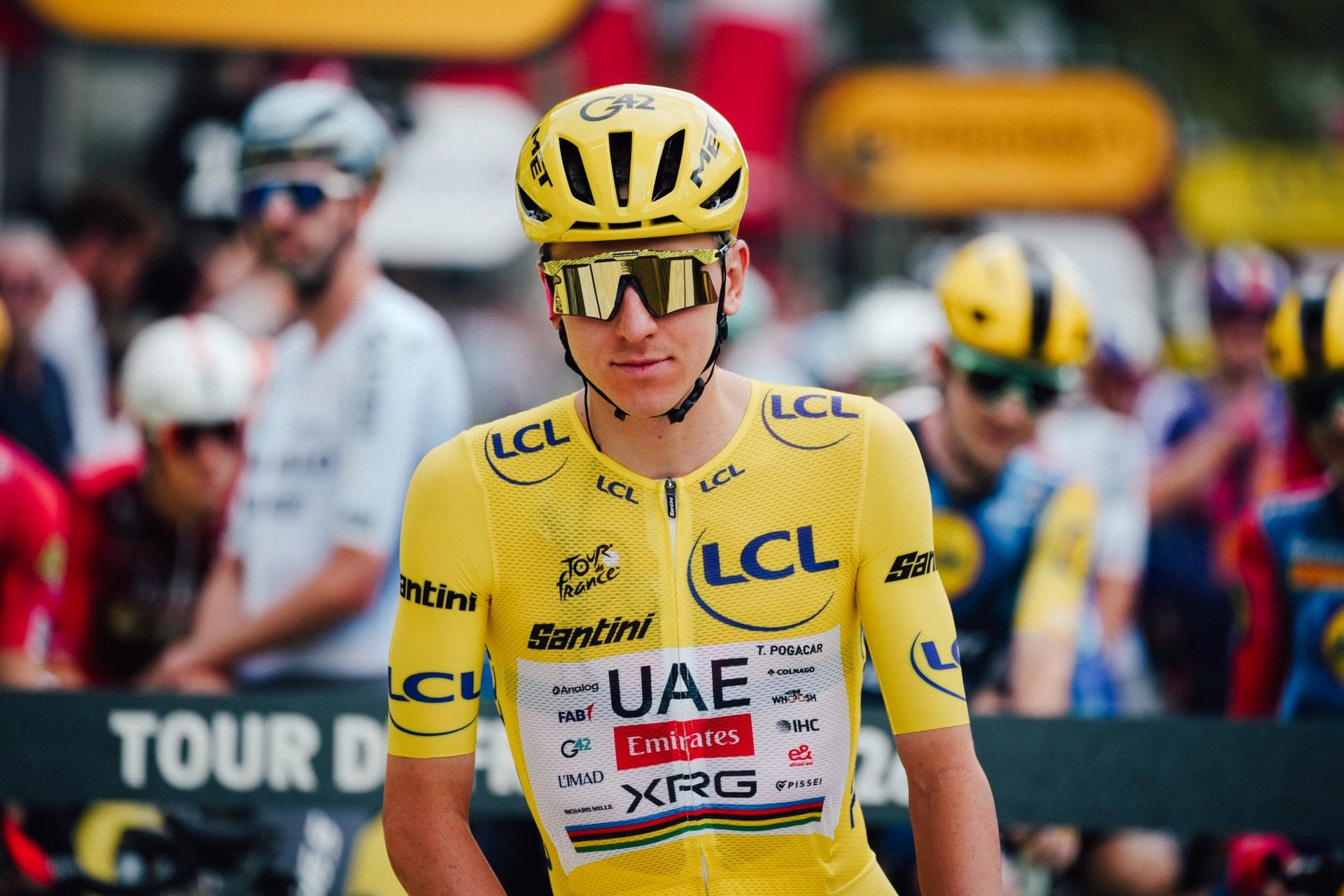
Anatomy of a G.O.A.T., the documentary about Tadej Pogačar, opens in Komenda, the Slovenian's home town, after the Tour de France he won for a record-equalling fifth time. Over the pictures, Pogačar (UAE Team Emirates XRG) talks about how much it matters to go home to friends, family and his home crowd, and about needing to enjoy every moment.
The 45-minute film, written and directed by Antoine Magnan, premiered on Saturday, November 7 on TNT Sports 1 in the UK and Ireland and on HBO Max across Europe and the US. It is the first in a new documentary format from Eurosport and TNT Sports. It is split into five chapters, each examining a different part of Pogačar's performance, and its selling point is WHOOP data that has never been published before.
The data justifies watching it. Its sports-science explanations are excellent and its graphics are exceptionally clear. Away from the science, though, the film offers little of real interest. It is polished and beautifully made, but it lacks grip. Plenty of viewers will disagree, I’m sure, but this is what reviews are for, after all.
The style follows the very popular modern streaming true-crime documentary that is often seen on Netflix. Interviews are intercut with race commentary, atmospheric music and crowd noise to build a tense feel, and the film jumps between races from 2019 to 2026. Alongside Pogačar and his parents, Mirko and Marjeta, the contributors include his former coach Iñigo San Millán, sports scientist Jean-Benoît Morin, WHOOP's Kristen Holmes, TNT Sports presenter Matt Stephens, Geraint Thomas, Alberto Contador and Pogačar's former teammate Matteo Trentin (Tudor Pro Cycling Team).
Where the science works
The numbers the film presents as most remarkable are not always the most revealing. Pogačar's resting heart rate is 38bpm, against an average of around 42bpm among his UAE teammates. That is low, but it is not unusual among professional cyclists. Mathieu van der Poel has reported the same average, with a recorded low of 34bpm.
 Photo: Thomas Maheux
His heart-rate variability matters more. Pogačar's HRV is 100ms, compared with around 80ms for his teammates. The film links this to faster reactions, greater sharpness and less effort for the same output, but HRV is an indicator of autonomic function and recovery readiness, best interpreted against a rider's own baseline rather than teammates' readings.
The lactate figures make the starkest comparison. Pogačar's blood lactate reading is 1.5mmol/L, where other riders in the team sit at 5mmol/L. The film explains this as Pogačar fuelling his muscles almost constantly while others have to wait, but lactate is used continuously by other riders too; the relevant distinction is his exceptional lactate-clearance capacity. As it does throughout, it draws on examples from other sports and leans on visuals. Viewers who find this subject interesting but have never understood it should come away understanding it.
Recovery is where the film argues Pogačar pulls further clear of his rivals. His sleep does not suffer during a race. During the 2026 Tour, he slept better than he does in normal training.
The strength section gives much of the credit to Javier Sola, who has overseen Pogačar's preparation since late 2023. Sola's focus on strength training, with the core and glutes at its centre, is presented as a key reason Pogačar can ride away from rivals while staying in the saddle.
The rest of the film is weaker. It tries to cover every angle of Pogačar, including how he handles races, how he lives day to day and what his team is like, but outside the WHOOP figures it shows nothing particularly new. The interviews with Pogačar and his parents produce few memorable or revealing moments.
The former champions mostly add to the admiration. Thomas recalls Pogačar riding up alongside him at Liège–Bastogne–Liège, while Thomas was doing "over 400 watts easily", and starting a conversation. "He has another gear or two than me, that's for sure," Thomas says.
Contador calls Pogačar "the best cyclist of all-time" and compares him to Usain Bolt, "in every race he competes in from February to October". Eddy Merckx, whose involvement had been announced in advance, makes only a brief appearance, though he delivers the film's headline verdict.
None of this is wrong, and much of it is well filmed. But once the science ends, the documentary mostly repeats how good Pogačar is. Towards the end, Matt Stephens calls the phenomenon "Pogimania". That is what most of the film is.
We usually save star ratings for kit reviews rather than films, but we'll apply the same five-star scale here. I am usually a harsh critic, but there is plenty of skill to appreciate in this documentary. The graphics and explanations of the data are superb, even if the rest lacks real wow factor. It doesn't reach four stars, but it edges up from two and a half to three, partly because we can't help indulging our own Pogimania.
Rating: ★★★☆☆ (3/5)