It's been a little over a week since the Brussels Court of Appeal dismissed the UCI's appeal against the suspension of its Maximum Gear Ratio Test Protocol, on 20 May 2026, leaving the rule shelved and giving SRAM a legal victory to the delight of many cycling tech obsessives. Norton Rose Fulbright, the law firm that represented SRAM, has now published a detailed account of the ruling, explaining why the court sided with the American drivetrain manufacturer on every ground, and it offers an interesting insight on where these cases may go in future.
The court upheld the Belgian Competition Authority's (BCA) October 2025 interim suspension in full, finding that the BCA made no manifest error in concluding that the protocol was, on its face, a restriction of competition law. The suspension remains in force to prevent what the court described as serious, imminent, and irreparable harm to SRAM and the professional cycling teams using its equipment.
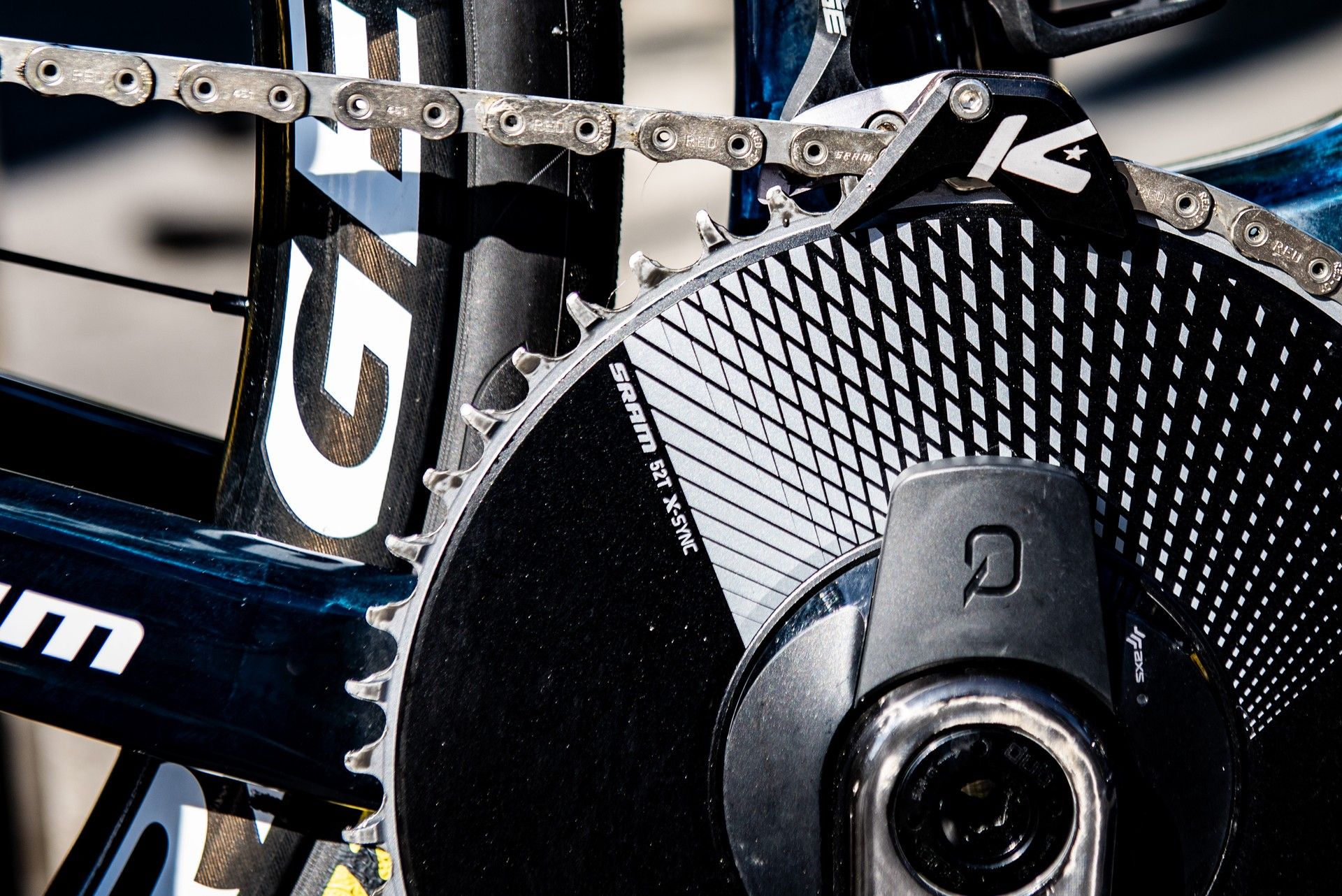
The dispute centres on a rule the UCI adopted in June 2025 following discussions within SafeR, its safety advisory body. The protocol capped maximum gear development at 10.46 metres per pedal revolution, the distance a bike travels for one full turn of the pedals, equivalent to a 54-tooth chainring paired with an 11-tooth cog. The UCI said the aim was to limit extreme rider speeds as a safety measure, and that the rule applied uniformly across the peloton.
SRAM's RED AXS groupsets use a 10-tooth smallest cog. Under the protocol, teams running SRAM equipment would have had to mechanically and electronically block that cog or race with a degraded 11-speed configuration, while Shimano-equipped rivals could compete with their full, unmodified drivetrains. SRAM filed a complaint with the BCA, which ordered the protocol's immediate suspension on 9 October 2025. The UCI appealed and lost.
Why the court sided with SRAM
Norton Rose Fulbright's account identifies three main elements in the ruling, each grounded in European competition law and each reaching beyond the specifics of gear ratios.
First, on process, the court applied the European Court of Justice's Superleague and ISU case law, which requires sports federations adopting rules that bind athletes, teams, and equipment manufacturers to do so within a framework based on substantive criteria and procedural safeguards ensuring transparency, objectivity, precision, and non-discrimination. Without that framework, the rules are treated as harmful to competition by their very nature, without any need to examine actual market effects.
The court found serious deficiencies at each stage of the UCI's rule-making. SafeR, the body that developed the safety recommendation, excludes equipment manufacturers. The court was direct on this point, stating that "the fact that equipment manufacturers will be consulted at a later stage is irrelevant, since it is the adoption of the standard that must be governed by substantive criteria and procedural rules designed to ensure its transparency, objectivity, precision, and non-discrimination."
Second, on jurisdiction, The UCI argued that as a sports regulator with no commercial stake in the drivetrain market, it should fall outside competition law. The court rejected this, holding that the Superleague standard applies irrespective of whether the federation has a conflict of interest or competes in the market it regulates. The trigger is the impact on the economic activity of market players.
Third, on the safety defence, The court accepted that rider safety is a legitimate objective but held that the UCI had not demonstrated why it could not be pursued through a fair process. Existing accident data from races where both transmission systems were already in use had not been analysed. Teams were willing to share their data. The court also found that forcing SRAM-equipped teams to race on a limited system "could potentially lead to more accidents and thus skew the test results," and that "other measures, potentially causing less distortion, could have been considered."
Yves Botteman, the Norton Rose Fulbright partner who led the SRAM team, said the ruling "establishes a powerful new standard for how international sport governing bodies must be held accountable in their rulemaking." He said it was "equally vital that international federations operate within a robust framework, one that guarantees genuine representation and meaningful participation from all stakeholders, including athletes, teams, and equipment suppliers."
The court ordered the UCI to pay €1,883.72 to the BCA and €400 to Belgium's Federal Public Service Finance body, plus a contribution to the legal aid fund.
Norton Rose Fulbright argues the ruling has implications well beyond cycling. Most international sports federations act as regulators without competing commercially in the markets they oversee. Following this decision, any such federation operating in or affecting the European market faces a clear procedural standard for the rules it adopts.
The UCI has confirmed that the protocol is not applicable and that no gear-ratio limitations currently apply to events on the UCI International Calendar. Any future attempt to regulate gearing for safety purposes will need a more open process from the start.
The ruling in brief
- The Brussels Court of Appeal upheld the suspension of the UCI's gear-ratio protocol in full, so no gearing limits currently apply on the UCI International Calendar.
- SRAM's 10-tooth cog fell foul of the 10.46m cap, meaning its teams would have had to block the cog or race a degraded setup while Shimano rivals ran full drivetrains.
- The court found the UCI's rule-making lacked a fair, transparent process, and that SafeR excludes equipment manufacturers.
- It accepted safety as a legitimate aim but said the UCI never showed why it couldn't be pursued fairly.