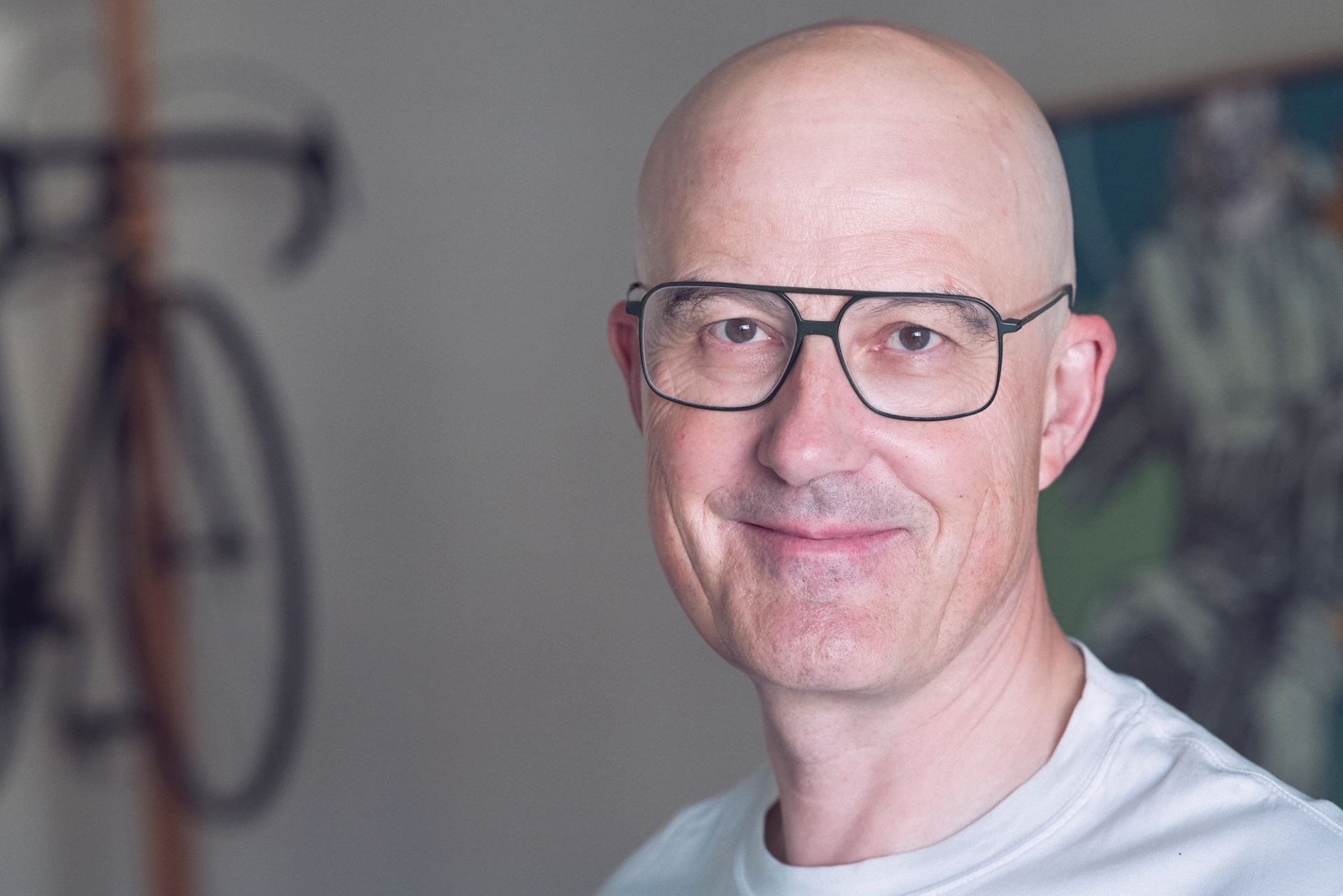
Roman Arnold, founder and CEO of Canyon Bicycles, is not a man prone to hyperbole. He’s one of cycling’s biggest industrial figures, and he’s deeply economical with his words. Yet, speaking in London recently, the direct-to-consumer pioneer offered an unvarnished assessment of the collective mania that gripped the cycling industry during the pandemic years.
‘How crazy can this whole industry be that we all believed the bicycle was the new gold?’ Arnold asked. ‘Everybody was thinking it was the boom and it will always go like this. Because our supply chain is so long, everybody over-ordered and then we had all the over-supply which still is some problem today.’
It was a rare admission of corporate hallucination from an executive class that often prefers the language of “headwinds” and “right-sizing”. And it captured, in a single phrase, the defining commercial story of modern cycling: a pandemic-era surge that felt like a permanent step-change, followed by a correction so brutal it reshaped brands, inventories, pricing and confidence.
As 2025 closes, the industry is only just beginning to emerge from the hangover. The question now is not simply how the boom happened, but what the bust revealed, and what the next cycle will demand from bike, kit and platform brands.
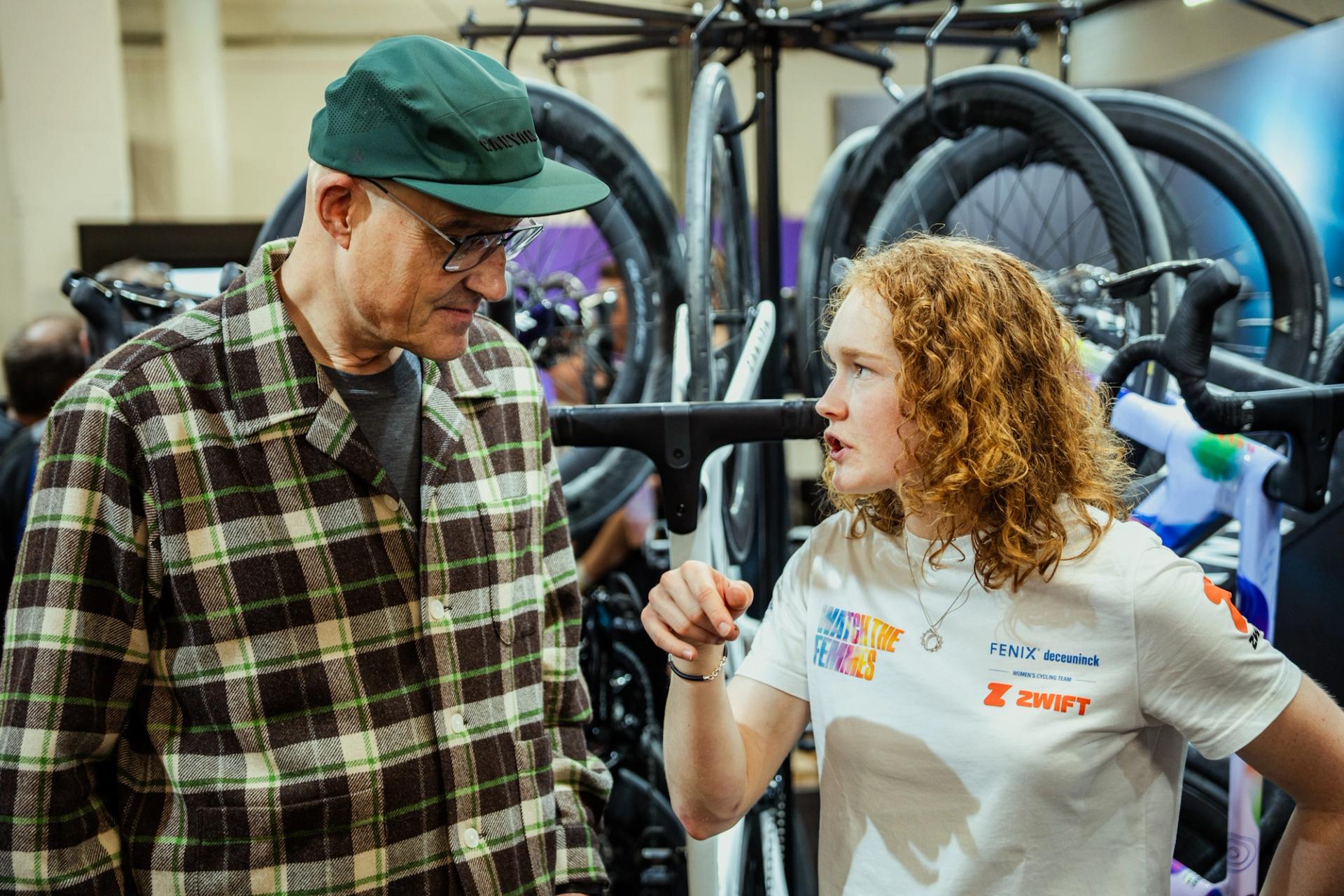
Roman Arnold and Puck Pieterse in London at the Rouleur Live show. Credit: Canyon
Industry humility on a Rouleur Live stage
We were watching Arnold speak at Rouleur Live in London, in a discussion hosted by Rouleur owner Matteo Cassina. On stage with him were Zwift CEO Eric Min and POC CEO Derek Bouchard-Hall. The audience was thick with industry people.
The shared theme was the turbulence of the past five years: supply-chain shocks, unprecedented demand, then steep discounting and inventory glut. Yet what made Arnold’s remarks stand out was his willingness to describe the boom as a collective misread, rather than a hard-to-predict external event.
That misread was structural across the European and American cycling industry. Cycling’s lead times are long. Tooling, production slots, component availability and shipping windows mean decisions made on imperfect data can (and did) echo for years. When demand spikes, everyone tries to lock in supply. When demand drops, those same purchase orders keep arriving.
Arnold described how, at the start of COVID, the instinct was to hit the brakes.
“When COVID came, I got a call from my investor in San Francisco and he said, ‘Roman, I have one thing for you. You have to step on the brake. Usually our portfolio companies are too slow in adapting to new situations. So, we want you to really go down with all your costs’,” Arnold recalled.
Like most of the industry, Canyon expected a slowdown. Then the opposite happened.
“And then COVID came. We were afraid like everybody. But then it turned out: wow. It was an advantage for Canyon of course because people could order bikes – where all the shops were closed – and the business really went up.”
Indeed, direct-to-consumer brands, and digitally mature businesses more broadly, benefited early. When physical retail shut or constrained access, brands that could sell, fulfil, service and communicate at distance had a temporary structural advantage.
The data advantage, and the ordering spiral
Arnold also offered a useful, under-discussed detail: early in the boom, Canyon had clearer, faster demand signals than many competitors, precisely because it sold directly.
“I also remember Shimano – they asked us hey how’s the business doing? What is happening here? How many orders? Because we were direct-to-consumer and we had more data than the other guys.”
In other words: suppliers were asking Canyon what the market was doing, because Canyon could see it in real time.
But even with better data, the ordering spiral took hold across the supply chain. Arnold positioned Canyon as relatively cautious.
“I would say Canyon was a little bit more cautious than the others in estimations for the future. So we always had double-digit growth but we were not crazy that we then said we want to have a 200% growth.”
Then came the moment that, in hindsight, explains much of the glut.
“But by the end of the year when I came to Asia most of the factories said: Roman, we are already occupied. There are one, two of your big American competitors who placed so much more orders than you.
“Shimano maybe had far more than 1000% increase in incoming orders,” Arnold added.
“So [the question is] how to deal with this, and all the problems we still see today?"
Arnold’s acerbic analysis doesn't strike as a critique of ambition, but of extrapolation. Cycling briefly started planning as if it had become something it had never been before: a mass-market with permanently accelerating growth.
Eric Min: 'It just went bonkers'
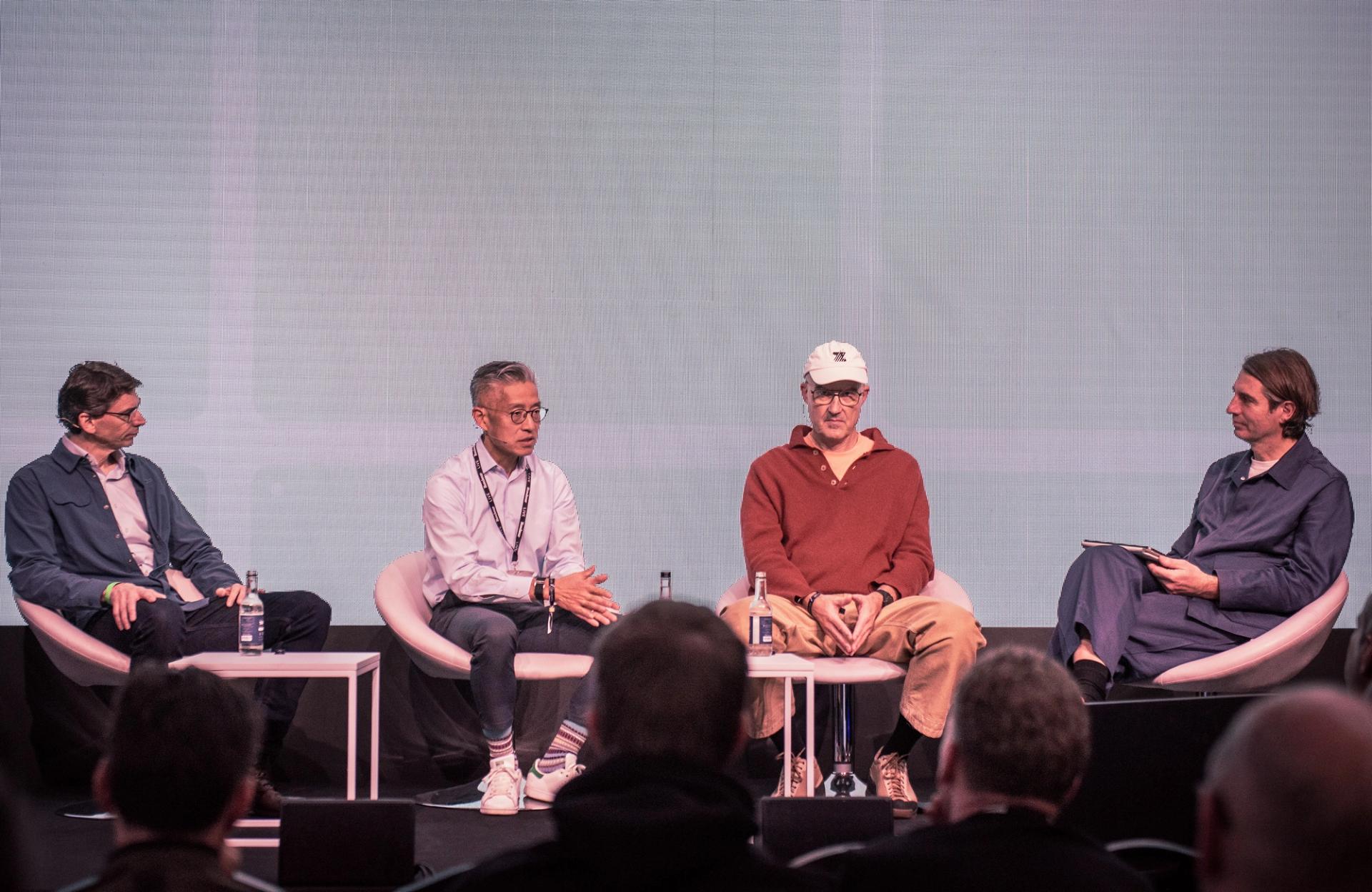
The panel on stage - Photograph: Peter Stuart/ Velora Cycling
Zwift’s Eric Min described a parallel story from the platform side, and Zwift’s meteoric rise tracked an indoor cycling surge depicted most publicly by Peloton’s now legendary rise and fall.
Zwift had invested in infrastructure to scale before the pandemic hit, and when demand surged, it was able to capture it.
“Right before COVID we were maybe close to 200 people. And we were lucky because we had been investing for the prior couple of years in infrastructure so that we can scale the business.”
He recalled the moment in early 2020 when the world shut down, and the initial assumption that sport itself would pause.
“I remember saying to some of my friends that the Tour de France is not going to happen. March Madness is not going to happen. And both things were true that year.”
Then came the surge.
“But what we were fortunate is that with COVID, people started to show up and it just went bonkers – people from Italy and Spain and France, they could not even exercise outdoors. So people were showing up with all sorts of equipment that they could find.”
For Zwift, demand spiked in a way that was less constrained by physical supply and more constrained by digital scalability and staffing. In the platform world, capital can buy speed. In the bike world, capital can’t conjure shipping containers filled with products if the supply chain doesn't have capacity.
Min delved into his fundraising psychology.
“It was exciting, but we were very fortunate that we were able to handle the volume. So it was exactly when we were looking to raise more capital and we were one of those internet businesses that just could come command the valuation, the capital,” Min said.
“This is one of the lessons I learned as an entrepreneur. You raise money when you don’t need it. When you need the money, and you have to raise it, that’s when you have those difficult conversations.”
He said Zwift raised around $450 million in that round, calling it “absurd”, but during a boom time it gave the brand capital to experiment, grow, and test ideas while the opportunity window was open.
What the bust revealed: innovation pressure and product sameness
The most forward-looking part of Arnold’s contribution to the roundtable was not about inventory, but about innovation, and the uncomfortable implication that cycling’s product language has started to converge.
In a raw, free-flowing section of the discussion, Arnold argued that he is still “in the right industry” because it is fuelled by passion and has genuine tailwinds, including broader participation. But he also suggested that many brands will not make it, and that differentiation is becoming harder.
His point was brutal but candid: at the high end, products increasingly look and perform similarly.
“If you look at the bikes, how different are the bikes looking?”
He reached for a historical analogy. He referenced Columbus (the Italian tubing manufacturer) and the era when many Italian bikes were built from the same tubesets, with differentiation coming from details rather than fundamentally different platforms.
Then he made the modern comparison: carbon, aero knowledge and manufacturing have matured.
“When you look 10 years ago, there was not the knowledge about aerodynamics. There was not the knowledge about carbon fibre technology. It was a new technology.
“It was also a transition where many of industry couldn’t make it,” Arnold added.
“But now we are in a space where it looks like there’s not too much innovation on carbon frames and this also will make our life more difficult.”
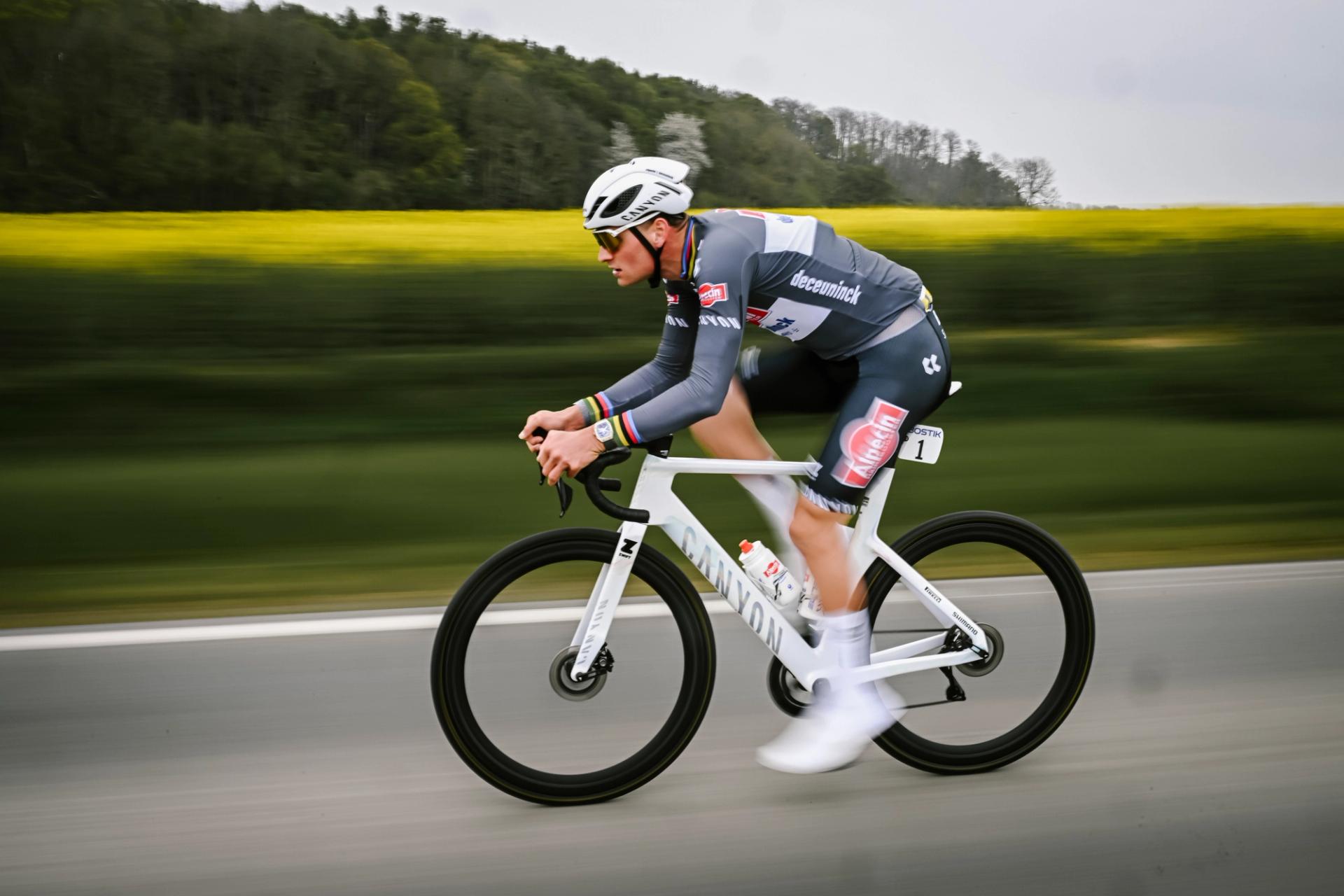
Canyon has invested heavily in brand alongside product, with Mathieu van der Poel being one of its most iconic riders
He extended the same argument to helmets and jerseys: once the big leaps are made, surviving on incremental gains and marketing alone becomes harder. In that environment, innovation is not a nice-to-have. It becomes the price of admission.
“So we need innovation to survive in the future.”
This is an unforgiving truth for the post-pandemic era – if the market is no longer rising fast enough to lift everyone, and products are increasingly comparable, the industry has to rediscover meaningful differentiation. That could be technology, but it could also be experience, service, ecosystem, community, fit, software and content.
China: threat, model, opportunity
Arnold then pivoted to China, describing it in a way that will make many European executives uncomfortable: not as a cheap manufacturing base, but as a service and systems leader that the West should study.
He pointed to the scale of infrastructure investment, describing cycling-only roads and large-scale bike networks, and contrasted that with what the UK and much of Europe lacks.
He also described Chinese brands and suppliers moving rapidly upmarket, producing high-end quality, including in components. His example was the wheel sector, where many rims trace back to a small number of factories, and that the organisation and output quality in those hubs is extremely high.
The message was not simple alarmism. For Arnold the message about China's ascension is to be wary, yes, but don’t pretend it isn’t happening, and don’t assume Western brands will automatically dominate the future.
“So on one hand, we should be afraid,” he said, “but we should see how to work together, how to find the opportunities.”
He suggested that China’s consumer and service expectations are already ahead in certain respects, and that success there demands more than shipping product into a market.
“If you want to sell a bike there, you also have to deliver a community.”

Image credit: Canyon
To put it more simply, he concluded, “In the end you have to do China for China.”
The message chimed with all the panel, who all had experimented in China: Either you invest properly, or you fail.
The clearest takeaway: cycling can’t run on collective optimism
Across the conversation, one idea kept surfacing. The pandemic over-inflated demand, but also the certainty of a continued growth curve. Perhaps that’s a symptom of an industry full of people who believe in cycling’s mission to improve society, and its potential to grow.
Brands started behaving as if cycling had permanently changed its growth curve. Suppliers responded. Capital flowed. Production locked in. And then the market snapped back to something closer to its historical shape, leaving the industry to absorb the consequences.
Arnold's analysis, blunt though it may be, points to the reality that the damage was not only caused by external forces, but by internal behaviour: overconfidence, extrapolation and herd decision-making in a long-lead-time industry.
Min’s fundraising lesson complements it – when the world is euphoric, capital is easiest. When the world tightens, capital becomes scarce and loaded with conditions. That shapes what gets built and what survives.
It didn't help that the industry was effectively flying blind. Unlike car manufacturers, who pool their data to track real-time demand, cycling has always operated in silos. Without a shared view of the market, brands mistook the panic-ordering of dealers for sustainable consumer appetite.
US bicycle trade group PeopleForBikes has very recently launched a new data exchange which may partially close that blind spot, but more globally the same errors may well be made if another boom takes hold.
The post-2025 question is what cycling chooses to learn. If the next growth phase arrives, the industry will have to resist the temptation to plan as if it will never end. It will also have to confront a more existential challenge: in a crowded market where the hardware increasingly converges, the winners may be those who innovate not only in carbon layups or aero wattage, but in the total value proposition around the bike.