Cycling is one of the Summer Olympics' biggest sports, with the Paris Olympics hosting a whopping 514 cyclists across multiple cycling disciplines. The Winter Olympics, meanwhile, does not host a single one.
That may seem natural; cycling is not an ice and snow event, but cycling does have a winter discipline in the form of cyclocross.
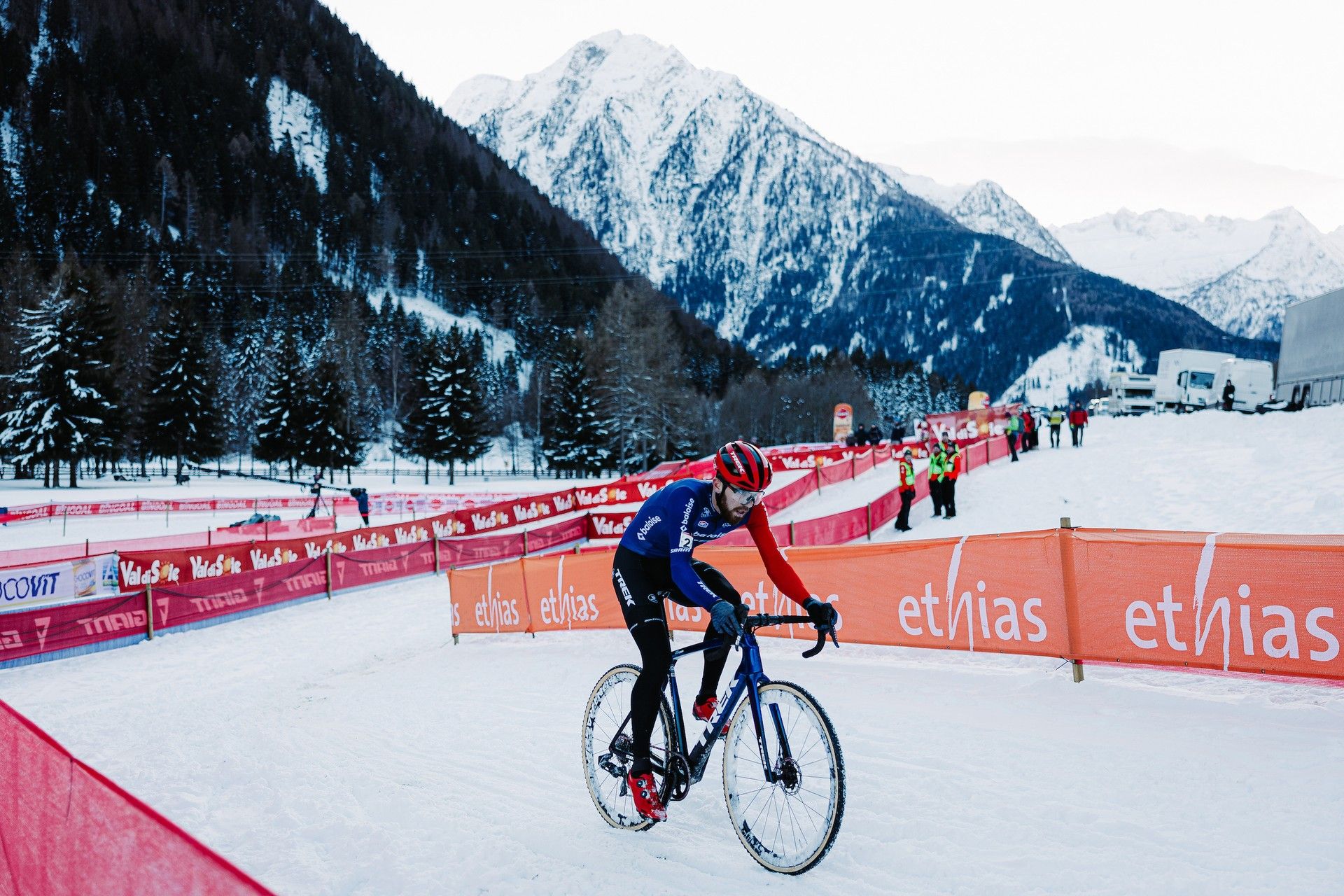
Cyclocross frequently takes place in icy conditions, and frequently on snow-covered courses. What's more, the International Olympic Committee needs to increasingly reflect on its mix of sports given that climates are warming, and so ice and snow sports are becoming more difficult to participate in, and confined to ever smaller geographies.
No wonder, then, that concerted efforts have been made to make cyclocross part of the Winter Olympics, and it may soon find itself on the programme.
A Song of Snow and Ice
The International Olympic Committee will decide in June 2026 whether to relax its "snow and ice" mandate for the Winter Games programme, a move that could clear the way for cyclocross and cross-country running to make their debut at the 2030 Winter Olympics in the French Alps.
As we reported in December, the decision – originally expected earlier this year – was postponed by the IOC Executive Board to allow more time for its "Fit For The Future" working group, led by Karl Stoss, to evaluate whether the Winter Games should expand beyond disciplines held exclusively on frozen surfaces.
At the centre of the debate is Article 6.2 of the Olympic Charter, which states: "Only those sports which are practiced on snow or ice are considered as winter sports." Cyclocross, a discipline that takes place overwhelmingly on mud, sand and grass during the winter months, does not currently meet that definition.

UCI President David Lappartient and World Athletics President Sebastian Coe have mounted a joint lobbying effort to change that, proposing a shared-venue model in which cyclocross and cross-country running would use the same infrastructure and terrain at the Games, reducing construction costs and environmental impact.
La Planche des Belles Filles, a climb in the Vosges region made famous by the Tour de France, has been floated as a potential host site for both disciplines in 2030.
Arguments for inclusion
The joint bid rests on several pillars that align with the IOC's stated modernisation objectives: cost control, sustainability, universality and youth engagement.
On the commercial side, cyclocross brings numbers that compare favourably with several established winter disciplines. The 2025 UCI Cyclocross World Championships sold 40,000 tickets and 4,500 VIP passes, giving the sport what Lappartient has described as a hospitality profile comparable with top-tier football. On average World Cup rounds draw around half a million viewers per weekend.
The presence of crossover stars such as Mathieu van der Poel (Alpecin-Deceuninck), Wout van Aert (Visma-Lease a Bike) and Tom Pidcock (Q36.5) has increased the sport's commercial profile. All bring significant personal fanbases from road cycling to the cyclocross circuit.
However, the sport remains heavily reliant on those marquee names. Van der Poel, Van Aert and Pidcock have all scaled back their winter racing calendars in recent years to prioritise road commitments, and now race less frequently in elite cyclocross events.
Brendan Quirk, the CEO of USA Cycling, has expressed confidence in the bid, suggesting to Cyclingnews a better than 50% chance of a 2030 debut and describing cyclocross as a potential "breakout star" by the 2034 Games in Salt Lake City, where, he noted, the sport's domestic popularity is already "off the charts."
Coe has offered a similar assessment, citing a "good chance" for 2030 and the willingness of the IOC's new leadership under President Kirsty Coventry to "think differently" about the programme, in an interview with the Guardian.
The cross-country running element of the joint bid has been central to Coe's pitch. Coe has argued that the discipline would give African nations, which dominate middle-to-long distance running, a realistic pathway to Winter Olympic medals for the first time. The Winter Games have long faced criticism for their lack of global diversity, with medal tallies overwhelmingly dominated by wealthy Northern Hemisphere countries.
Backers of the bid also highlight sustainability. Cyclocross courses require minimal permanent infrastructure and are, in Lappartient's phrase, "temperature-agnostic," functioning regardless of snowfall or ambient conditions. Bid supporters say this resilience is attractive to organisers facing rising costs for artificial snow production in Alpine host cities.
Lappartient has called cyclocross inclusion a "massive priority" for the UCI, arguing that while ice and snow are the "DNA of the Games," the seasonal timing of cyclocross makes it a natural fit. Lappartient also brings political connections: the UCI president previously served as the head of the French National Olympic Committee and maintains a close relationship with French President Emmanuel Macron.

The UCI has staged World Cup rounds at Val di Sole in Italy on fully snow-covered courses and says this shows that cyclocross can meet the charter's current surface criteria. While those events were successful, proponents acknowledge that the sport's core identity involves mud, sand and grass, making a broader charter reinterpretation preferable to permanently altering course design.
Supporters and opponents broadly agree on the proposal's details but take different positions on its implications for the Winter Games' identity.
Summer sports creep
The Association of International Olympic Winter Sports Federations (AIOWF), representing disciplines including biathlon and luge, remains the strongest institutional opponent. The organisation has argued that admitting non-snow sports amounts to "summer sport creep" and has described the proposal as an attempt by the UCI and World Athletics to claim additional Olympic medals without competing in the more crowded Summer Games programme.
Traditional winter federations have warned that expanding the programme risks diluting the "brand, heritage, and identity" of the Winter Games. Their concern extends beyond symbolism to funding: new disciplines would compete for IOC revenue shares, host-city budgets and television windows already under pressure. The IOC has recently lost major sponsors including Toyota and Panasonic, intensifying competition for commercial resources across the programme.
Some critics have also questioned why cyclocross and cross-country running do not simply seek inclusion in the Summer Olympics if they are popular enough to warrant Olympic status. Proponents counter that the sports' competitive seasons align with winter, making a summer slot logistically impractical.
There is also a concern about precedent. If the "snow or ice" requirement is removed or softened, the distinction between the Summer and Winter Olympics becomes primarily calendar-based. That could invite further crossover requests from other sports, such as judo, which has already been mentioned alongside the CX-running bid as a possible Winter Games addition.
The CX calendar and cash
The impact of Olympic inclusion on the broader cyclocross ecosystem is another area of uncertainty. An Olympic slot could accelerate investment in women's and U23 racing pathways, categories where development funding currently lags behind the men's elite scene. Equally, restructuring the winter calendar around a February Olympic window could create scheduling conflicts with the existing World Cup series and national championships that form the sport's commercial backbone.
The sport's television audience remains heavily concentrated in a handful of European markets, principally Belgium, the Netherlands and France. Bid supporters point to recent digital growth figures as evidence that interest in cyclocross is increasing beyond its core European markets.
Since the initial drafting of this piece, a further development has slightly shifted the dynamics. Het Nieuwsblad reported that winter sports federations would be willing to drop their opposition, on the condition that the UCI does not request additional financial support or revenue from the IOC as a result of cyclocross’ inclusion.
For the IOC, the June decision will affect more than one discipline. If the IOC's working group recommends relaxing Article 6.2, it will establish a framework that future sports can use to seek Winter Games entry.
If the working group upholds the existing rule, it will confirm that the Games remain restricted to sports on snow and ice.
The "Fit For The Future" working group is expected to present its recommendations on Article 6.2 and the wider Winter Games programme ahead of the IOC's June 2026 decision.
So in a few months we will have a definitive answer as to whether the 2030 Games will feature cyclocross. Even if shelved for the next cycle, though, it's hard to imagine the question of cycling at the Winter Olympics disappearing altogether.
Note: This article was updated on 10 February to reflect new reporting regarding the position of winter sports federations.