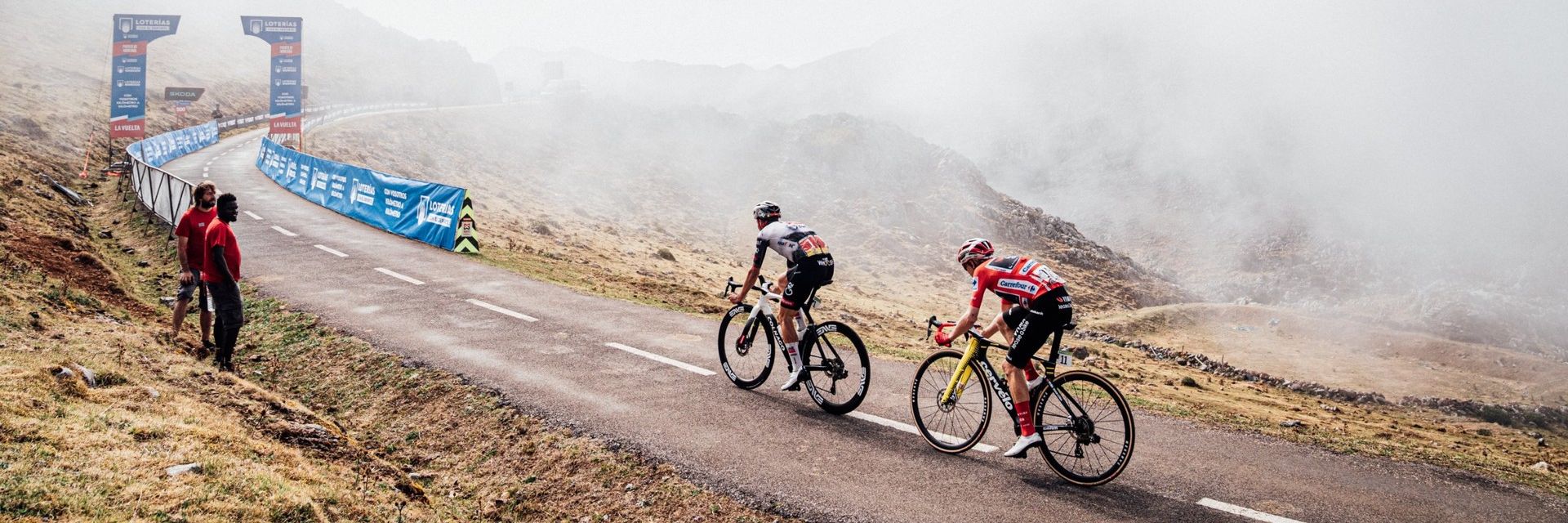
Vuelta a España director Javier Guillén has agreed to inspect two dirt tracks that would give the Angliru a gravel approach. Former Riosa mayor José Antonio Muñiz put the idea to him at an awards event in Riosa on October 31.
Muñiz, president of the Asociación de Amigos del Angliru and one of the original promoters of bringing professional racing to the climb, described two tracks of around 3km that join the existing ascent at Llagos, Diario AS reported. After that junction there would be less than 5km left of the famous climb before the summit. This would still include the steepest gradients, hitting almost 24%, but not the whole classic climb. Guillén will look at the tracks with the race's technical staff, on condition that they add interest to the stage without overloading its difficulty or compromising safety.
Guillén said the climb was already "at the limit of extreme difficulty", but added: "We listen to every idea." Riosa's current mayor, Roberto Álvarez, also backed the proposal.
The Angliru has featured in the Vuelta 10 times since 1999. It is usually climbed over about 12.4km at close to 9.8%, and it closed the women's race in May. The gravel would replace the lower slopes. The final ramps would remain part of the route.
What Bartolo showed
This year's stage 6 to Castelló on August 27 is the closest comparison. Puerto El Bartolo included a 1.9km dirt sector averaging 11.8%, which ended 21.8km from the finish. Tadej Pogačar (UAE Team Emirates XRG) attacked on the climb. Enric Mas (Movistar Team) caught him just before the summit, and the pair began the descent about 30 seconds clear. Pogačar won the two-up sprint and the next five riders finished 46 seconds back.
The climb split the field, but the descent was where the stage nearly went wrong. Pogačar missed a bend with 19km to go and briefly left the road before rejoining Mas. He crashed out two stages later.
Oscar Onley (Netcompany INEOS) cramped on the run-in and finished 1:38 behind Pogačar. "The gravel went on for longer than I thought it would. I probably just overcooked here a little bit and paid the price towards the top I think," he said in his post-stage interview.
At the Angliru, the gravel would lead straight into the steepest ramps and the stage would end on the summit, with no descent afterwards. That puts the focus on positioning and mechanical support. On the 2024 Tour de France stage around Troyes, which had 32.2km of gravel, Jonas Vingegaard (Team Visma-Lease a Bike) punctured on the third sector and took the bike of then teammate Jan Tratnik (now Red Bull-Bora-Hansgrohe).
"At the time of the puncture, the team car was about three minutes behind Jonas because of the commotion. If Jan hadn't been around Jonas, we probably wouldn't be so satisfied," sports director Grischa Niermann said.
At the 2021 Giro d'Italia stage to Montalcino, crashes, a puncture and a mechanical problem hit the peloton as it split on the first gravel sector. Remco Evenepoel (now Red Bull-Bora-Hansgrohe) lost 2:08 to Egan Bernal (Netcompany INEOS) that day. Bernal's decisive attack came on the tarmac of the Passo del Lume Spento, after the gravel had already thinned the group.
The organisers will inspect the route but it is another situation where gravel is pushing into the Grand Tours whether it is wanted by teams and fans or not.