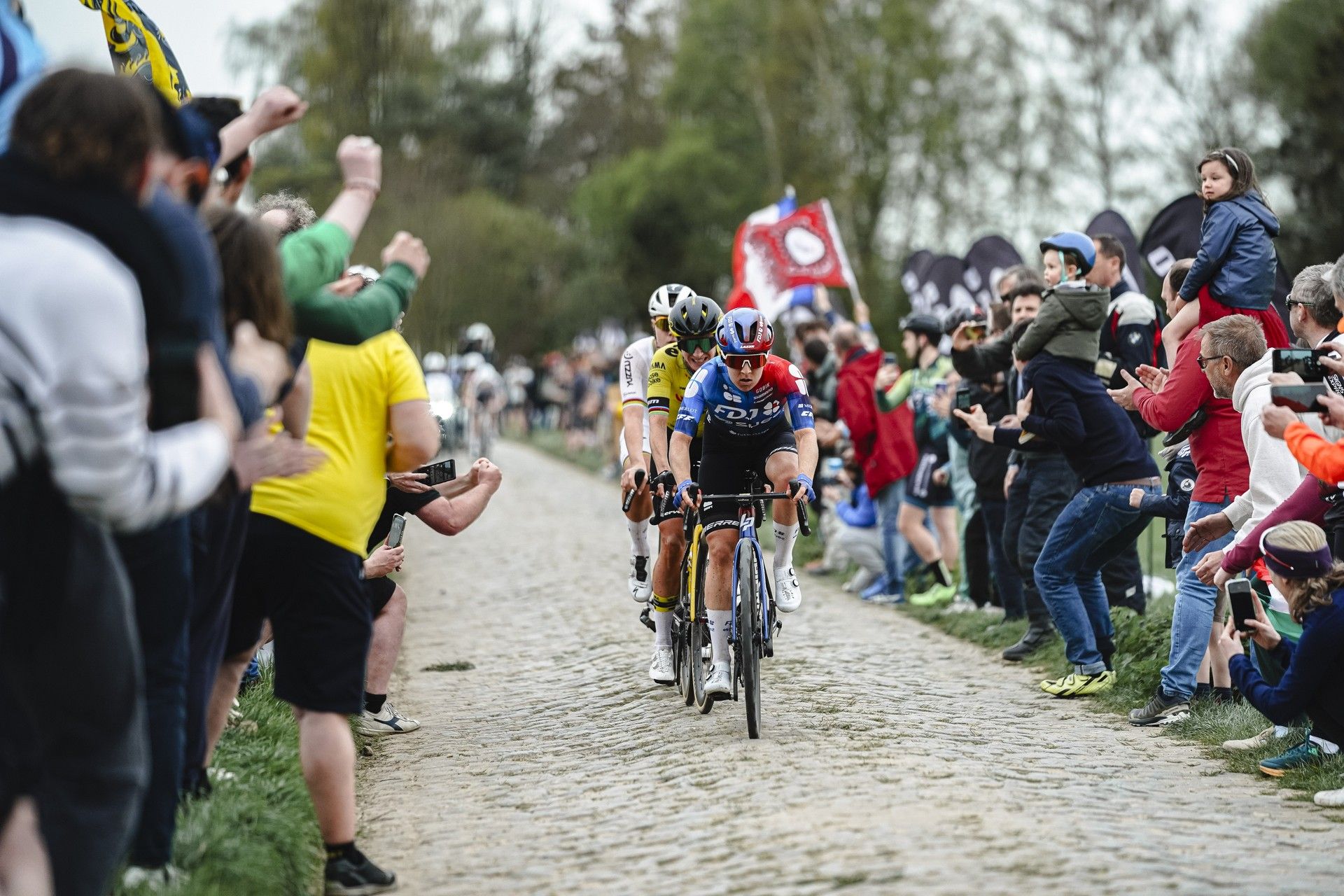
Annemiek van Vleuten and cycling analyst Marijn de Vries have warned that Paris-Roubaix Femmes on April 12 faces a crowd safety risk, after a barrier collapse at the Tour of Flanders on April 6 nearly sent Mathieu van der Poel (Alpecin-Premier Tech) into fallen spectators on the Oude Kwaremont.
The concern centres on a 2026 scheduling change that places the women's race on the same day as the men's event for the first time, meaning riders will pass through roadside sectors where fans may have been drinking for hours.
At this year's Tour of Flanders, during the second ascent of the Oude Kwaremont, a barrier gave way and a spectator fell forward onto the cobbles directly in Van der Poel's path. Footage and reporting from Sporza showed the Dutchman narrowly avoiding the person on the ground.
Speaking to Sporza, Van Vleuten said the problem was not crowd size but behaviour. "As far as I'm concerned, there can never be enough people on the roadside. I think that's wonderful," she said. "The problem is the amount of alcohol being consumed. It would be nice if people actually came for the sport. I think it's a shame that at some races it seems to be a booze festival."
Why Roubaix is more exposed
De Vries drew a line between the Flanders incident and the structural reality of Paris-Roubaix. At the Ronde, key climbs like the Oude Kwaremont are lined with steel barriers that contain crowds, even when those barriers fail under pressure. At Roubaix, she said, that level of containment is not feasible along the open, narrow cobbled sectors where spectators stand just centimetres from riders.
The timing of the women's race adds to the concern. Race director Thierry Gouvenou moved Paris-Roubaix Femmes from Saturday to Sunday for this year to share the day with the men's event, a change that was intended to simplify security logistics and raise the women's race's profile.
De Vries acknowledged those benefits but pointed to the trade-off. "The spectators have had the beers by then, and I don't know what will happen when the women still have to come through," she said in Sporza. She added that she would not be surprised if cobbled sectors were filled with fans walking back to their cars, no longer paying attention to the race.
Van Vleuten went further, floating the idea of restricting alcohol sales at certain events. "First, there's social responsibility, but perhaps we need to think about no longer serving alcohol," she said, while acknowledging that many fans consider drinking inseparable from the Paris-Roubaix experience.
De Vries was more cautious on that front, calling an outright ban "a step too far" given the commercial realities of sponsorship and beer sales at roadside events. Her argument was that organisers need to confront the practical consequences of a long day's drinking on sectors where physical crowd control is minimal.
Van der Poel's team, Alpecin-Premier Tech, has called for coordinated action. In a statement the team urged "dialogue and cooperation among all involved parties, riders, teams, federations, organisers, and government authorities, to implement measures that prevent individuals with bad intentions from infiltrating cycling events."
Contact between riders and spectators at Paris-Roubaix is not out of the question at all. A stand out moment of this is when, in 2022, Yves Lampaert (Soudal-Quickstep) was riding the penultimate sector, Willems a Hem, when a spectator was leaning out into the road as Lampaert tried to stay on the asphalt. He clipped the spectator and went careering head over heels to the other side of the road and landing in a heap, seeing his podium chances ruined.
Paris-Roubaix Femmes is scheduled for Sunday, April 12. Whether ASO or the UCI announce additional crowd-control measures before then remains to be seen.