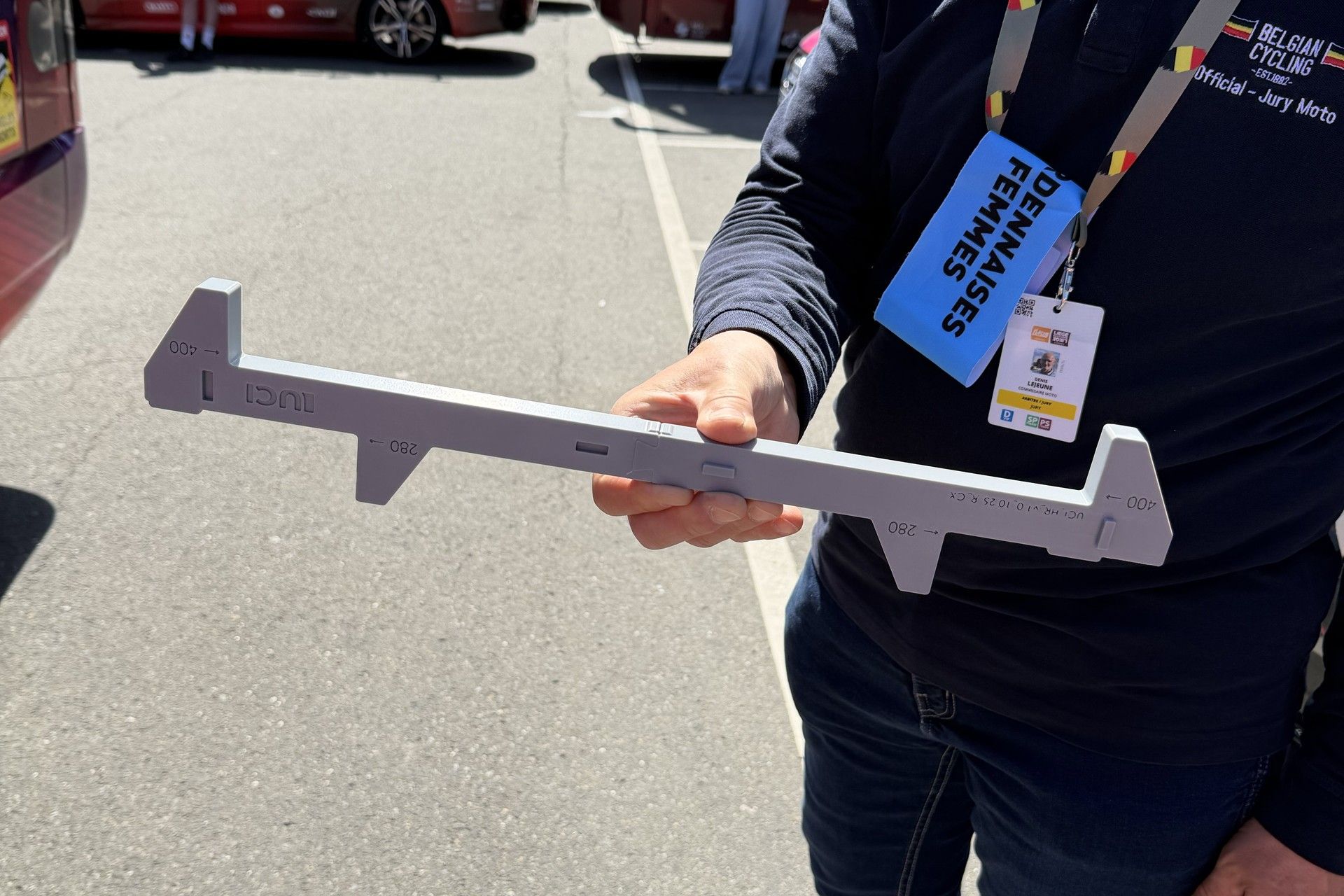
The UCI's handlebar-width measuring gauge is now well deployed in competition to support the UCI's new handlebar width rules, and the federation has released the specs for the two-piece tool to be recreated using 3D-printing.
At the weekend at Liège-Bastogne-Liège we made sight of the UCI's handlebar-width measuring gauge. Though far from new in competition, we were intrigued to see the tool in use - our YouTube Short below shows commissaires in action.
The files are hosted in the UCI's own model repository, and within weeks of appearing, independent makers on Printables had begun remixing the design to fix what they described as a series of printability problems in the original.
The gauge enforces Article 1.3.022 of the UCI regulations, which from January 1, 2026 requires road and cyclocross handlebars to measure at least 400mm at their widest point. The tool also checks the spacing between brake levers. The UCI's June 20 statement on the equipment changes refers to a minimum of 320mm between the inner edges of the brake levers, however this position was revised under heavy criticism from riders and teams. As a result, the rule was revised in September, and the downloadable gauge and its remixes check the correct 280mm dimension at the lever position, with the printed tool incorporating a 1mm tolerance (measuring 279mm and 399mm in practice).
The gauge's logic is counterintuitive. If the 400mm side of the gauge fits over the widest part of the handlebars, those bars are too narrow and fail. If the smaller side fits between the brake levers, that is a pass. One remix on Printables addressed the confusion by adding embossed text reading "CLEAR = PASS" and "CLEAR = FAIL" to the respective sides.
What the makers found wrong
The UCI's original design is a two-piece gauge joined by a dovetail, sized to fit in toolboxes and printable on most 250mm print beds. Several remix authors said the execution needed work. Common complaints included dovetail geometry that required support material, overly deep and thin embossed text, UCI logo stripes rendered at 0.09mm (too thin to appear in most slicers), and overhangs at the centre joint.
One remix replaced the original notch system with holes for 10x3mm press-fit magnets, which the author said held the halves together "FAR more effectively" and added the side benefit of sticking to a refrigerator. Other changes included chamfered edges, adjusted overhangs, and thicker logo stripes compatible with Arachne-based slicers.
The UCI positioned the width rule as part of a broader safety package developed with input from riders, teams, organisers and the SafeR rider-safety body. The federation said the measures were introduced "in a context marked by rapid technological advances and a significant increase in racing speeds that could have an impact on rider safety." It said the 400mm minimum corresponds to 380mm centre-to-centre, "a standard commonly used in the cycling industry."
Critics have argued the rule is blunt. “This rule disregards the realities of our bodies and how we race, creating unnecessary risk," The TCA's rider representative Ellen van Dijk said in 2025. "Every rider deserves equipment that fits and supports their safe performance. We welcome the opportunity to consult with the UCI to ensure safety regulations are based on evidence, not assumptions”.
The gauge now exists in two forms: the UCI's official design and a growing set of community remixes. Which version a commissaire or team mechanic uses, and whether altered files still capture the official dimensions, remains an open question as the rule beds in across the 2026 season.
For those eager to push the limits of their bike setup in UCI sanctioned events, the files could prove invaluable. For 3D-printing enthusiasts, the files may offer an opportunity to refine and develop the UCI's design.